
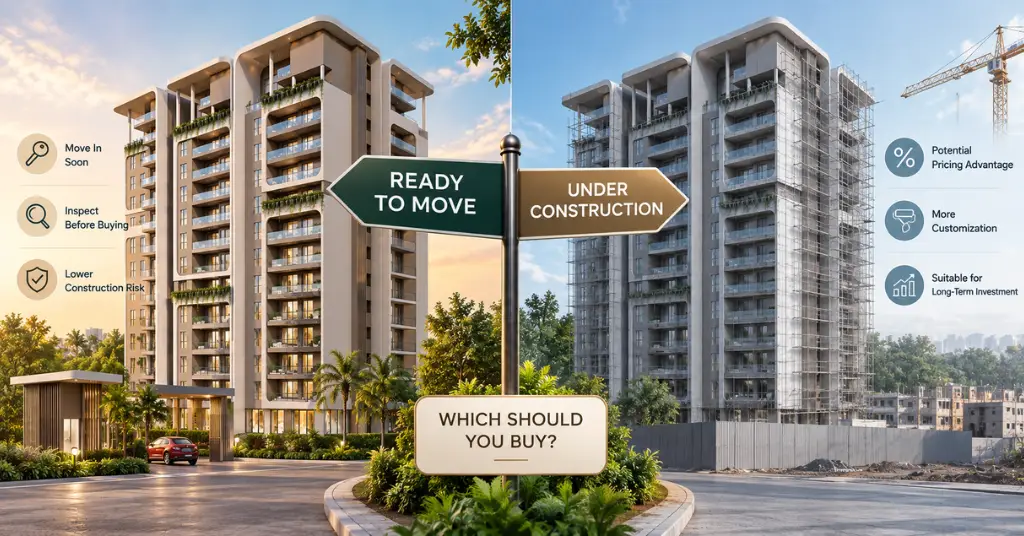
Buying a home is a key financial choice, and one of the first choices you will make is whether to buy a furnished-pass property or spend money on construction work. Both options have their own blessings, fees, and considerations.
Geared up to move vs under creation: understanding the differences between homes will allow you to choose furniture that fits your price range, timeline, lifestyle, and financing goals.
A ready-to-move household lets you move almost immediately, while under-construction properties give you the opportunity to buy a household that is nevertheless advanced and can benefit from certain pricing and customizations.
So, which one should you choose? Let’s consider two options in the element.
What Is a Ready-to-Move Home?
A home equipped for circulation is a property where the production is finished and the house is to be owned, but there is a problem with the relevant approvals and documentation.
Depending on the assignment, buyers can inspect the rental properties themselves, learn the layout and finishes, and move in after completing the necessary buy-and-hold formalities.
For buyers who no longer have to wait many years for a creation to be completed, a tailored property stream can offer convenience and more authenticity to what they can buy.
What is a house under construction?
Underproduction domestically is an asset developed anyway during your purchase. Construction may have begun, but neither the lease nor the house is ready for ownership.
Buyers typically pay according to the assignment’s cost schedule and wait until construction and necessary approvals are complete.
Under-creating homes can be appealing to buyers who have broadened their investment horizons or want to go all the way through the next stage of improvement.
Ready-to-Move vs Under-Construction: Key Differences
When comparing ready to move vs under construction properties, there are several factors to consider.
| Factor | Ready to move home | Under-construction home |
| Possession | Usually available soon | Requires waiting |
| Property inspection | Actual property can be inspected | Based on plans, specifications, and construction progress |
| Construction risk | Lower | Higher |
| Waiting period | Minimal | Can extend until completion |
| Immediate occupancy | Possible after formalities | Not possible until possession |
The right option depends on your individual circumstances rather than simply choosing one category over the other.
Ready-to-Move Homes vs. Under Construction: Which Is Better?
The comparison between ready to move homes vs under construction properties becomes easier when you consider your priorities.
-
Possession Timeline
One of the biggest differences is the time required before you can use the property.
With a ready-to-move home, construction is already complete. This can be especially useful if you are currently renting a home and want to shift into your own property soon.
With an under-construction property, you have to wait until the project reaches completion and possession becomes available.
If immediate occupancy is your priority, a ready-to-move property may be more suitable.
-
Ability to Inspect the Actual Property
A major advantage of buying a ready-to-move home is that you can physically inspect the property before completing the purchase.
You can look at:
- Room sizes and layout
- Natural light and ventilation
- Construction quality
- Finishes and fittings
- Common areas
- Parking arrangements
- Views from the apartment
- Surrounding development
When purchasing an under-construction home, much of your decision is based on approved plans, specifications, sample apartments, construction progress, and the developer’s commitments.
-
Construction and Possession Risk
Cracked-to-move-into-property vs. subconstruction. Another important aspect of the valuation is construction risk.
With the completed property, most construction-related uncertainties have already been resolved. You can check the condition of the finished product by looking at it.
Sub-creative assets carry additional uncertainty because completion depends on the creation process, approval funding, market conditions, and other work-related factors.
This no longer means that every degrading operation is unstable. The developer’s tune file, mission approvals, regulatory compliance, and construction progress should all be assessed before investing.
-
Fee and Budget
The payment method can also fluctuate between the two options.
Purchasing goods up to prepared sales may also require a very large payment at the time of purchase, according to the transaction and the financing company.
Sub-production houses usually take care of a creation-related payment plan, where invoices are made for a specific range of developments.
This allows checkout slide design plans to be unique to customers.
However, consumers should understand the entire payment schedule, credit terms, relevant taxes, listing prices, protection fees, and differential costs carefully before making a decision.
-
Rental Income and Immediate Use
Usage time is especially important if you’re buying a lot of appliances for an apartment function.
After the ownership and ownership formalities are completed, it is possible to rent out a furnished-past-due property so that the owner can quickly start generating apartment profits.
A material under design generally cannot generate residential income until it is completed and can be owned.
Therefore, investors need not forget about the expected waiting period when calculating the capacity yield.
-
Customization and Personalization
Another focus within the relocation vs demolition apartment contrast is personalization.
A finished apartment usually comes with construction, layout, furnishings, and finishes already determined.
A sub-production asset can also provide additional opportunities for certain completions, improvements, and change choices, depending on how quickly you enter the challenge and what the developer enters.
However, adjustment should not be expected at all. Buyers should confirm exactly what changes are allowed and whether or not they will incur additional charges.
-
Place and Environmental Development
The surrounding neighborhood is another critical focus.
With full content, users can compare existing infrastructure and environments without delay. Look for nearby roads, colleges, hospitals, commercial areas, public transportation, and various amenities.
In a downstream project, some surrounding infrastructure may also be growing anyway.
It creates opportunities on increasing levels, yet additionally law purchasers will carefully assess future development plans instead of just relying on advertising projections.
Under Construction Projects vs Ready to Move House: Investment Perspective
Under creation vs. ready-to-move-in dwelling: Buyers need to look past the initial purchase price when evaluating.
Products under construction can also provide an opportunity to enter the campaign earlier, undoubtedly making the most of future growth and value addition; however, the return will depend on market conditions, proximity, mission delight, and crown pricing timelines.
However, a move-in ready property gives a clearer picture than a finished property. Investors can evaluate the property itself, the community, housing options, and existing infrastructure before making a decision.
For businesses that pay for certainty and immediate utility, rich homes can be attractive. Those with an extended investment horizon are also called back for thorough due diligence on under-construction projects.
Factors to Check Before Buying Either Property
Whether you’re choosing a finished home or a work-in-progress, don’t make it easy to choose based on price.
Consider:
- Developer Reputation
Research the developer’s past work and build joy, deliverables, and customer experiences.
- Location
Look at connectivity, infrastructure, social facilities, business centers, and future improvement opportunities.
- Legal Documents
Verify title deeds, approvals, plans, agreements, and various applicable and criminal documents with professional assistance where appropriate.
- RERA Details
For RERA-covered projects, check the applicable state RERA authority for business registration and availability of information.
- Total Expenses
Look beyond market fees. Consider registration costs, applicable taxes, maintenance, parking, furnishings, mortgage costs, and other related costs.
- Build quality
For wealthy households, look at the domestic communal area itself. For dwellings under construction, assessment specifications, construction process, and report by the builder.
Why Choose Aryan Milestones?
Choosing the appropriate home is not enough gear up-to-flow and bellow-creation homes have to contemplate. The developer behind the challenge also plays an important role in your purchase choice.
Arya Milestones has construction of top-rate residential estates with emphasis on thoughtful planning, good construction, natural light, ventilation, privacy, and a comfortable stay.
With extensive engineering experience, Logo brings a quality-oriented approach to residential construction in Bangalore. Its homes are designed to combine affordability with the needs of a modern lifestyle, allowing total residents to enjoy a significant portion of property purchasing for adventure.
For clients looking for top-tier homes, a comparison of the builder’s experience, construction methods, challenging specifications, and near-term, long-term values can be just as necessary as determining when things might be ready for ownership.
Making the Right Choice for Your Future Home
Deciding between a well-maintained import and a substandard homestead ultimately depends on your priorities.
If you use temporary ownership, ability to track affluent properties, and more facts, ready-to-flow home can be a good suit If your appearance time and comfortable to evaluate construction and business-related hazards, properties under construction can additionally offer homeowner opportunity management.
Evaluate the entire price, property timeline, zone, builder approval, legal documents, project approvals, and your personal financial dreams before making the ultimate choice.
After all, buying a home is definitely not a speculative property decision—it’s about choosing an area and financing that can help you with your plans for years to come.