
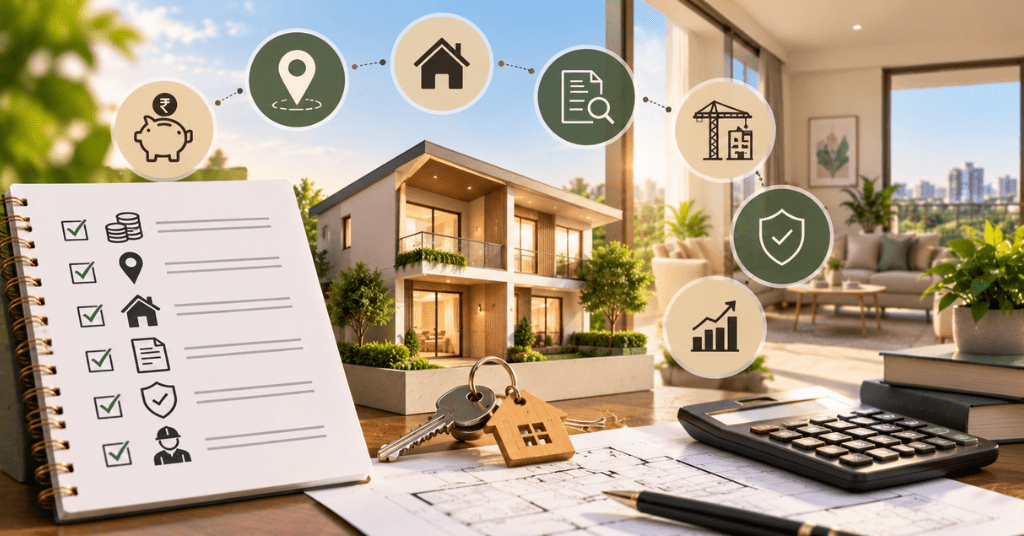
Owning your own house is something to be very happy about, but at the same time, it might be very scary. From figuring out how much you can pay for the house to choosing the appropriate location, verifying legal papers, applying for a loan, and understanding the contract, there are several factors that need to be taken into consideration.
Being a first-time home buyer, having an action plan may make the procedure easier and prevent you from costly errors. Be it purchasing an apartment for your family or investing in real estate, these first home buyer tips will be useful for you.
1. Determine Your Realistic Budget
When choosing properties, set out the figure you can actually afford first.
The budget cannot be solely determined by the total cost of housing that can be provided by the bank. Think about your monthly income, other financial responsibilities, savings, and future spending.
Keep in mind other costs that will go beyond just the cost of the property itself, which include:
- Down payment
- Stamp duty and registration
- Home loan processing fees
- Maintenance deposits
- Parking fees, where necessary
- Interior design and furnishing costs
- Moving costs
- Others
A realistic budget can help you avoid getting financially burdened after buying your own house.
2. Save for the Down Payment
The down payment is one of the largest initial costs in acquiring a home.
Commence saving early and keep aside a special fund for your home acquisition. Do not use each rupee of your savings in making your down payment, as you must have some savings even after acquiring your property.
Some savings will help you cope with any unforeseen expense without being dependent on any further debt.
3. Know About Home Loan Options
Home loans are significant for most first-time buyers.
Consider home loan options based on their:
- Rate of interest
- Loan tenure
- Processing charges
- Prepayment conditions
- Other charges
- Total interest payable
Do not consider a loan simply because it comes with the lowest rate of interest. Be clear about its total cost and terms.
It is better to know about an EMI within your budget capacity rather than borrowing a maximum amount.
4. Choose the Right Location
Location is crucial, as it affects your way of living, the price of your property, and even resale or rental value in the future.
When buying your first home, think about your daily commute and ease of access to amenities.
Think about:
- Road connectivity and transport
- Schools and colleges
- Hospitals
- Entertainment and shopping destinations
- Job centers
- Places to eat and other facilities
- Current and upcoming infrastructure
An excellent-looking flat that is located inaccessibly is not a good choice if it causes you troubles during your everyday routine.
5. Think about the Future
Do not select a home on the basis of your present needs.
Think about how your needs might change in five to ten years. In case you are planning to expand your family, work from home, or accommodate your parents, then it will have an effect on your choice of property.
Think about:
Will I still need this house in several years?
6. Research the Developer
The developer you choose may be just as critical as the real estate asset.
To find out whether you are dealing with a good developer, study his past projects, quality of construction, project delivery record, customer feedback, and reputation.
Choose a developer who stresses openness, quality, planning, and client experience instead of purely relying on marketing.
For a newbie buyer, it is much easier to deal with a trustworthy developer.
7. Check the RERA Registration
Another vital tip for a first-time home buyer is checking the regulatory information about your purchase.
For those real estate assets regulated by the Real Estate (Regulation and Development) Act, 2016, contact the appropriate state RERA regulator to check the registration and disclosures of the project.
Among the information you need to consider, there are:
- Project registration
- Promoter information
- Disclosed completion period
- Project description
- Disclosures and approvals
- Construction stage
However, RERA registration is only a small part of due diligence.
8. Inspect the Property Carefully
Never base your buying decision entirely on brochures, photographs, or even a sample apartment.
In case you are buying a ready-to-move-in flat, be sure to check the unit yourself.
Check:
- Room dimensions
- Light and ventilation
- Floors and finishings
- Doors and windows
- Electrical connections
- Plumbing
- Kitchen layout
- Bathroom fittings
- Storage
- Balcony
- Common areas
In case of an under-construction property, crosscheck the agreement against the plans and specifications offered by the developer.
9. Get Clarification on Carpet Area and Total Area
There can be many terms associated with properties, and some may even create confusion for first-time buyers.
Get clarity on carpet area and built-up area, among other relevant areas.
It is essential to know about carpet area, especially since it helps you understand how much space you can use inside the flat.
Instead of comparing flats based on their total area, you should compare them based on their usable area and layout.
10. Check All Legal Documents
Never overlook the legal due diligence.
Before buying the property, ensure that all the required documents about ownership, title, approvals, development rights, etc., have been checked out.
According to the requirement, such documents may include:
- Documents of title
- Documents regarding approved building plans
- Permissions that may be needed
- Records relating to encumbrance
- Agreement of sale
- Documents of RERA
- Tax records of the property
- Occupation or completion documents (if any)
As property laws and documentation vary from place to place, you should get the documents checked by a property lawyer.
11. Calculate Total Cost of Ownership
The cost of your property is not the same as its purchase price.
It includes both recurring and non-recurring costs associated with your ownership of the property.
Such costs may include maintenance charges, taxes on the property, utility bills, insurance, interest payable, interiors, repair, and other costs involved in owning the house.
This is especially important for the first-time buyers because a cost-effective purchase price can prove costly due to these costs.
12. Compare Multiple Properties
Do not make the mistake of buying the first property you see.
Rather, shortlist some properties and compare them on the basis of:
- Location
- Price
- Carpet area
- Layout
- Quality of construction
- Amenities
- Developer’s reputation
- Connectivity
- Possession time frame
- Maintenance expenses
- Further development plans
The comparison will give you a clearer idea about what kind of value you can have from your budget in the market.
13. Always Read the Agreement Before Signing It
This document is very important in the process of buying the house.
Do not blindly accept the fact that the sales person says that the agreement is always standardized.
Some points to be considered from the agreement are:
- Specifications of the property
- Schedule of payment
- Possession
- Cancellation of the deal
- Delay
- Maintenance issues
- Parking facilities
- Extra costs and charges
- Obligations of buyer and developer
14. Do Not Ignore Resale and Future Value
Even if the property is bought mainly for your own family, you should still consider its future value.
It is impossible to foresee the future property market trends, yet location, accessibility, infrastructure, quality of construction, neighborhood, and the developer’s reputation may have an effect on the future demand.
When buying a house that will fit you at the current stage of your life and at the same time will be appealing to future buyers, you will give yourself more room for movement.
15. Don’t Rush While Making a Decision
Probably, the main first-time home buyer tip is as follows: don’t hurry.
Buying property can cost quite a lot of money, and decisions made in a hurry can bring disappointment.
Do not hurry to:
- Visit the property several times
- Choose between alternatives
- Study the documentation
- Understand your financial state
- Discuss the issue with family
- Investigate the neighborhood
- Ask questions
- Look through the contract
If a realtor tries to push you into a quick decision due to a very short deadline for the special offer, just give yourself some time to think.
What Should First-Time Homebuyers Prioritize?
For an individual buying a first-time home, it might not be easy to identify the aspects that need more consideration.
In order to help make the right decision, you may want to consider separating the decision-making process into five different categories.
- Finance: Do you find it easy to afford this home and the expenses that go with it?
- Location: Is the location right for you?
- Home: Is the design and construction suitable for you?
- Developer: Do you find the developer to be trustworthy?
- Legality: Are there any legalities to take care of for the home?
When a home ranks well in all the above five categories, then you can proceed with confidence.
Why Choose Aryan Milestones?
Selecting your first home is not merely the selection of an aesthetically pleasing flat; you are selecting a place where you would live for many years to come.
Aryan Milestones is the creation of exquisite residential homes in Bangalore. It focuses on well-planned, good construction, use of natural light, proper ventilation, privacy, and a pleasant living environment.
The quality of construction, design, location, and the philosophy of the builder would go a long way in making your life as a homebuyer more comfortable.
While you evaluate the options that come your way, be aware that some features should take precedence over promotional discounts.
Final Thoughts for First-Time Homebuyers
Getting your first home doesn’t have to be difficult if done in a systematic manner.
This would entail knowing your financial situation, having a realistic budget, researching on locations and developers, validating all regulatory and legal aspects of the property, performing a thorough inspection of the property, and being aware of all costs associated.
Most important of all, always keep in mind that a cheap property is not always the best property. It must suit your financial capacity, style of living, future plans, and standards.
Here are some helpful first home buyer tips that could make the entire process much easier for you.