
Insights for Better Living

Explore expert perspectives, market trends, and practical guidance for smarter real estate decisions.

Latest Insights

Stay updated with the latest perspectives on real estate, design, and modern living.

Latest Blog

Best Area to Invest in Bangalore for Homebuyers: Why JP Nagar Stands Out

Bangalore has emerged as one of the most popular cities in India for those who are buying homes and investing in real estate properties.

But along with selecting the ideal apartment, selecting the right locality plays an important role in determining the property value of a place. Properties that offer connectivity, social infrastructure, developed area, and other factors may be highly valued.

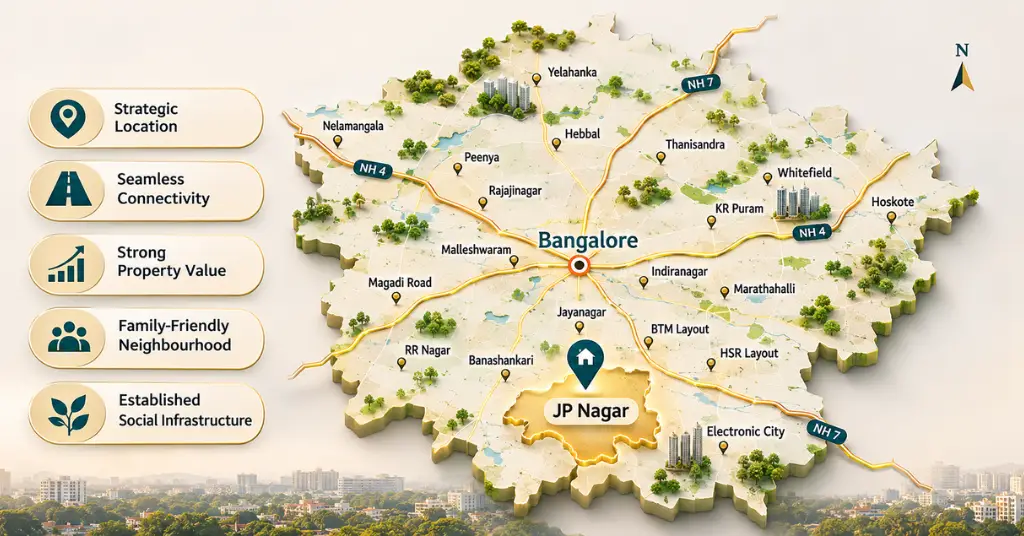
JP Nagar is one of the most popular residential areas in South Bangalore. The reason for the popularity of this area is its connectivity, convenience, and residential aspect.

No matter whether you are buying your first home or looking for investment property, knowing the advantages of JP Nagar will help you make an informed decision.

Let us look at why JP Nagar deserves to be considered if you are looking for the best place to invest in Bangalore.

Why Is JP Nagar a Popular Residential Destination in Bangalore?

JP Nagar is a well-established residential area in the southern part of Bangalore with well-organized residential localities and proximity to various everyday conveniences.

JP Nagar covers several phases and provides housing options in the form of independent houses, flats, commercial buildings, and gated residential societies.

Some of the factors that make it an attractive area to buy homes are listed below:

  • Established residential areas.
  • Presence of schools, hospitals, and shopping complexes.
  • Good connectivity to key roads and employment centers.
  • Options of different kinds of residential properties.
  • Parks, recreation centers, and lifestyle amenities.

As opposed to areas that have not yet developed their basic infrastructure, JP Nagar already enjoys an established residential ecosystem.

Reasons Why JP Nagar Stands Out for Property Investment

1. Strategic Location and Connectivity

Location is very crucial while assessing the various investment options for properties. The area of JP Nagar has the advantage of location, being located in South Bangalore and with easy connection with neighboring commercial and residential zones.

It has good connectivity via various roads like Bannerghatta Road, Kanakapura Road, and the NICE Road corridor. Such connectivity enables people living in the zone to reach various parts of Bangalore like Jayanagar, Banashankari, BTM Layout, and Electronic City.

Another advantage of the area is its metro connectivity. The existing Green Line is connecting some zones in JP Nagar, like Jaya Prakash Nagar and Yelachenahalli.

The upcoming metro line, the Pink Line, has an elevated portion in the JP Nagar 4th Phase and will provide better connectivity along Bannerghatta Road. 

The elevated portion covering 7.5 km has been cleared for safety in October 2026 and now awaits inauguration for passengers by the start of November 2026.

2. Well-Developed Social Infrastructure

The right choice of residential area should not only be based on nice flats or apartments but also on the availability of necessary services that can make life easy and also play a role in making it a desirable place to live in the future.

There is an excellent social infrastructure available in JP Nagar, including:

  • Educational Institutions: Availability of educational institutions such as Orchids The International School, Redbridge International Academy, etc.
  • Healthcare Services: Availability of healthcare services such as Aster Hospital, Manipal Hospital, Fortis Hospital, and many other healthcare services in nearby locations.
  • Shopping and Entertainment: There are some shopping malls like Forum South Bangalore and Nexus Vega City Mall, where one can do shopping, entertainment, and many other things.

Thus, it makes JP Nagar a good choice for families and individuals.

3. Access to Employment and Business Hubs

The employment environment of Bangalore is one of the main aspects affecting its residential property market.

The connectivity of the JP Nagar area to many business and employment centers in South Bangalore is provided by the existing road network.

Commercial developments and employment centers in the vicinity can create the demand for residential properties from professionals who need convenient accommodation.

This aspect is essential for investors in property markets since proximity to business centers may determine the demand for apartments and tenants.

4. Balanced Life Style with Parks and Recreation Facilities

In modern society, the growing number of people choose residential areas offering both convenient conditions for urban life and comfortable accommodation.

JP Nagar has a lot of parks, green spaces, restaurants, and recreational facilities contributing to the attractiveness of this locality.

Among natural sites worth mentioning in this respect, there are Sarakki Lake and Puttenahalli Lake. Also, localities have parks and places for walking.

The balance between residential and commercial zones allows residents to meet their daily needs without going a long way to do shopping.

5. Different Residential Options for Homebuyers

One of the features of JP Nagar is the diversity of the residential property options in the various phases.

Customers have access to both individual houses and apartments based on their requirements and financial capacity.

The earlier phases are usually more mature compared to the later phases, which include JP Nagar 7th Phase and JP Nagar 8th Phase.

Thus, this makes this locality significant for various categories of customers who could be families or investors.

However, there are many variations in terms of price and investment value for property based on the particular location.

Which Part of JP Nagar Should You Consider?

There are different phases in JP Nagar, each having a unique residential experience to offer.

JP Nagar Phase 

  • 1st-3rd Phase: Well-established residential colonies with good connectivity to Jayanagar and amenities available.
  • 4th-6th Phase: A combination of residential and commercial activities with good connectivity to major roads and lifestyle amenities. 
  • 7th-8th Phase: Relatively new residential layouts with good connectivity to Kanakapura Road and NICE Road

It is all about picking the right phase according to your requirements. If you are looking for well-established neighborhoods, the former might suit you better. However, if you are looking for relatively new residential layouts, then the latter might just be what you need.

It is always advisable to consider the exact location of the project and not the JP Nagar name alone.

What Should You Check Before Investing in JP Nagar?

While considering a property, there are certain important factors that should be kept in mind:

  1. Location & Accessibility: Determine the proximity of the property to metro stations, highways, and nearby places.
  2. Reputable Developer: Find out about the developer’s experience of building properties and their construction standards.
  3. Legal Documentation: See if the property is registered in RERA and other legal documentation and clearances are obtained.
  4. Amenities and Specifications: The facilities provided in the property and its specifications.
  5. Overall Cost of Investment: This would include base price, registration fees, taxes, and other costs, like for parking facilities.
  6. Future Demands: Select a property according to your family’s future demands and needs.

Final Thoughts

The selection of the right locality plays an important role in ensuring the success of real estate investments. Among the many interesting places for residence in Bangalore, JP Nagar is considered the best one owing to its developed infrastructure, connectivity options, and access to places of employment.

JP Nagar can be considered the best area in Bangalore for real estate investors considering current advantages as well as the possibilities of future connectivity.

Nonetheless, any good investment requires thorough research and realistic planning of finances along with assessing the selected property.

At Aryan Milestones, we are convinced that the house has to give more than just a nice address. Therefore, it has to be designed with comfort in mind and built with high-quality materials.

Find out all the advantages of your future home, Aryan Alturra, in JP Nagar 8th Phase.

Frequently Asked Questions (FAQs)

1. Is it a good choice to invest in JP Nagar, Bangalore?

Yes, JP Nagar can be a good choice owing to its existing residential infrastructure, connectivity by metro rail, educational institutes, healthcare services, and employment opportunities. Yet, the investment suitability will depend on the particular property and the cost of purchase.

2. Which phase is the best for buying an apartment at JP Nagar?

It will depend on you since some people like already developed locations whereas others would like to check out newly constructed residential units. It can be either one of the earlier phases or the 7th and 8th phases of JP Nagar.

3. Is JP Nagar one of the developing places in Bangalore?

JP Nagar is an established residential place and not fully emerging. Still, the current infrastructure development is adding value to the future connectivity of this locality.

4. What factors do I need to consider when deciding to invest in property in Bangalore?

Think about location, connectivity, developer’s reputation, RERA compliance, quality of construction, amenities available, total cost of purchasing, and rent demand before you make your choice.

5. Why should prospective buyers take into account Aryan Alturra in JP Nagar?

Aryan Alturra is a residential project developed by Aryan Milestones in JP Nagar 8th Phase, offering 3BHK homes and a few 4BHK duplexes.
Recent Blogs

Explore All Articles

Browse insights across categories to find what matters most to you.

Understanding PLC Charges in Real Estate: What Bangalore Flat Buyers Need to Know

Have you come across an apartment in Bangalore that you can afford, but the end amount that you have to pay comes out to be higher than anticipated? 

Well, the answer to that is preferential location charges, commonly called PLC. An apartment having a view of a garden or located on a higher floor or one that faces a main road will cost more compared to other apartments.

Knowledge about PLC charges in real estate will enable you to do a comparison between properties and avoid surprises while buying a house. It will be wise for you to know about these charges before making any advance payment.

What Is PLC Meaning in Real Estate?

Preferential Location Charges or PLC refers to the extra charges imposed by a developer for a flat having some particular location advantages in a housing project.

The meaning of PLC in real estate is quite simple; buyers can afford to pay more for those special features that make one flat superior to another, though both the flats are equal in terms of carpet area.

Let us consider an illustration where two flats exist in the same housing project of Bangalore. One of them is located in front of a landscaped garden, whereas the other is located near the internal service area. In such a case, the developer can impose preferential location charges on the garden-view flat due to its particular location.

It is important to note here that PLC is not a common or standardized type of fee with a certain fixed rate.

What Are the Common Types of PLC Charges?

The qualities which make PLC interested can be different for various constructions. Here are some examples:

1. Gardenside or Parkside Flats

Apartments which look at garden plots, parks or any other green areas might cost more than other units because they provide a view and good living environment.

2. High Floor Apartments

Some construction companies might increase the price of high-floor flats due to the view, lighting and privacy conditions. Still, it all depends on how the building and its location were designed.

3. Corner Flats

Corner apartments have special qualities such as extra windows, more ventilation or more privacy.

4. Units that Face the Road or Have Premium Views

A flat that has a certain view or location within the development can have a PLC. But just because the flat faces the road does not necessarily make it better, particularly when traffic noise and pollution become an issue.

Before you pay a premium, think about whether the feature will meet your requirements.

How Do PLC Fees Work?

The developers will compute the PLC either through the rate per square foot, a percentage of the cost of the property, or even a fixed fee for a certain feature. Each development will determine how PLC is calculated, so it is best to request a written computation.

Here is an example: If a developer will charge a PLC of ₹150 per sq. ft. on a flat with 1,000 sq. ft. area, then the computation is:

PLC = 1,000 sq. ft. × ₹150 = ₹1,50,000

This implies that the preferential location premium increases the base price of the property by ₹1.5 lakh.

In case of more than one premium being charged, find out whether the premiums are cumulative in nature and how the computation is done. It is also necessary to determine the chargeable area, as this would vary according to the conditions applicable.

Comparison Between PLC Charges and Other Property Charges

While making a comparison between the flats, it is necessary not to get confused between the PLC charges and other elements of the total purchase cost.


Charge  Covered
Base cost Basic cost of the property
PLC Premium for a preferential location/feature
Parking charges Parking charges, if any
Clubhouse charges Applicable clubhouse charges, if any
Maintenance charges  Maintenance costs of the property 

All projects may not charge extra for these components. Get a bill of cost breakup so that you know what is included in the cost and what needs to be paid separately.

What Should Bangalore Flat Buyers Look for Before Making Payment of PLC?

There are a variety of housing schemes in Bangalore, from small apartments to luxurious gated communities. As there will be variations in pricing patterns, looking into the details prior to booking will help you save yourself future hassles.

  • Study the Cost Sheet Carefully

Make the developer give you the PLC figure, what is the factor responsible for premium payment is, and how it is calculated. Find out if the sum is included in the quoted cost or not.

  • Compare Other Flats

Compare other apartments of comparable size in the same scheme. If the prices of two flats are different, find out why.

  • Read the Booking Form and Agreement

See whether the PLC and the calculation thereof is recorded in the booking form, allotment letter or the agreement for sale. It should not just be taken for granted that the sales team verbally tells you about it.

  • Think of the Real Value Added

An ideal location does not always add to your experience in the building. Before spending more, visit the site, see the view, know the traffic noise level and the development around it.

  • Look at the Total Purchase Price

The PLC should be considered along with the price, taxes, government fees, maintenance costs and any other disclosed costs associated with the flat purchase.

Does RERA Regulate PLC Charges in Real Estate?

The main objective of the Real Estate (Regulation and Development) Act, 2016 is to enhance transparency and accountability in the real estate industry. 

All developers of any projects falling under the Act must fulfill the pertinent requirements of registration, disclosures and contractual requirements.

RERA does not set one fixed PLC rate applicable for all residential projects. It is imperative for the buyers to review the pricing details provided by the developers, project documents and agreements to ascertain how premium is added.

In case of any additional or inconsistent charges, seek clarifications through writing. It will also be prudent to contact a property attorney or real estate regulatory authority in such cases.

Importance of RERA Registration When Working With a Property Agent

Apart from verifying property costs, buyers may approach a property agent for help with their purchase process. The agents will facilitate site visits and communicate with developers but it is always advisable to verify the pertinent information.

As per the RERA norms, all real estate agents involved in the transaction of properties that require registration must register themselves.

In case you are dealing with an agent, you can verify the registration details of the agent via the official RERA portal of Karnataka. This becomes more useful especially while comparing different properties and making the purchase of a property for the first time.

Steps Involved in Checking RERA Registration of a Real Estate Agent

In order to find out the credentials of an agent, one must visit the official RERA portal of Karnataka and search for the option related to the registration/status of the agent.

In case the required fields are available, one can use the name of the agent, company name or the registration details in order to verify the credentials of the same.

Checking for RERA registration for real estate agent details will be helpful in verifying the correctness of the registration details. One may come across phrases like RERA for real estate agent, RERA real estate agent registration and real estate agent RERA registration’ while looking for the process.

Even though buyers prefer RERA registered real estate agents, it does not necessarily mean that all claims made by the agent are true.

Conclusion

A premium load charge can affect the total cost of purchasing a flat, even if the size and project remain the same. Being aware of why the developer charges the premium, the method of calculation and if the feature justifies the additional cost can help you make an informed decision.

At Aryan Milestones, we understand that buying a flat starts from knowing the components of its cost. Before booking the flat in Bangalore, check the cost sheet, compare flats and check the relevant documents.

Frequently Asked Questions

1. What are PLC charges in real estate?

PLC means Preferential Location Charges. Developers can impose these extra charges based on certain special characteristics like garden facing, corner position or elevated floors.

2. Is payment of PLC charges compulsory for each apartment?

Not necessarily. It depends on how developers have decided to charge for different units in a building and what the special characteristics of that unit are. Always get it clarified in writing before you book.

3. How are PLC charges calculated?

They can be calculated on a per-square-foot basis, as a percentage of basic cost or fixed sum depending on the project.

4. Am I able to bargain over the PLC charges with the developer?

You can inquire about whether the premium is flexible or whether other units are available for a lower premium price. The answer would depend on the policies of the developer.

5. Is there any fixed rate of PLC for Bangalore apartments under RERA?

No fixed PLC rate is mentioned by RERA for all the projects. Consumers are advised to go through the relevant information disclosed by the developer.

6. How can one find out whether an agent selling properties in Karnataka is registered under RERA?

One can visit the official website of Karnataka RERA and make use of the search option for agent’s registration.

Have you come across an apartment in Bangalore that you can afford, but the end amount that

What Is Housing Demand? Factors That Influence Property Demand in Cities

Ever thought about the reason behind an increase in house prices in one locality and at the same time, houses being cheaper in another locality within the same city? The reason lies in housing demand. 

With growing cities and an increasing number of people seeking to move into a city because of job prospects and good education, there is a need for housing. But housing demand varies from place to place.

Knowledge of housing demand helps individuals buying or developing properties make well-informed decisions. A range of factors contribute to the level of housing demand for various reasons in any particular locality. 

Let us try and understand the concept of housing demand and its importance in India.

What Is Housing Demand?

The housing demand is measured by the quantity of houses consumers are ready and able to purchase or rent depending on the changing prices.

The housing demand is affected by factors other than the number of people looking to purchase a house. The income level, availability of mortgages, prices, and expectations are significant in the demand for housing.

For instance, the construction of an IT park in the city might attract professionals who decide to live close to their work stations. This could increase the demand for apartments and rental housing. In case the supply of available homes does not follow suit, the prices will definitely be driven up.

Nevertheless, high demand for housing does not necessarily lead to purchases. High demand means that the consumers wish to acquire the product, but they may fail to afford it due to the costs involved.

Housing Demand and Housing Supply: What Is the Difference?

In order to comprehend the dynamics of the property market, it is essential to differentiate between demand and supply.

Demand for housing reflects the desire to purchase or rent homes that buyers/renters can afford. Supply of housing consists of the stock of housing currently in the market as well as newly built houses.

Interplay between these two factors affects house prices, rental rates, and new home building.

If the demand increases faster than the supply, the competition for the available homes may arise. As a result, prices for housing may go up, especially in connected urban areas with limited land.

Alternatively, when the number of houses constructed by developers exceeds that of buyers’ demand, it will be hard to sell all of them. In such circumstances, developers will offer discounts or other incentives.

Supply and demand for housing provide useful explanations of the different behavior of property markets in various cities and neighborhoods.

Major Factors Affecting Demand for Housing in Cities

There are several economic, social and infrastructural factors that play a part in making housing decisions by people. The knowledge of such factors that impact housing demand can help buyers evaluate a particular area based on other parameters than just the existing housing prices.

1. Population Growth and Urbanization

Urbanization is characterized by the migration of people from rural and small towns to big cities as they seek jobs, education and better medical facilities. Such an influx of population leads to requirement for new houses.

Younger people might prefer having smaller houses in proximity to their workplaces while bigger families would prefer larger houses. 

However, depending on the location of such migration and the affordability of houses, urbanization can have a varied impact on housing demand.

2. Employment Opportunities and Income Levels

One of the most powerful factors that influences housing demand is employment. Cities with rapidly developing information technology industries, manufacturing companies, financial services and other businesses will be attractive for employees who will need housing.

If people have higher incomes, there may be more potential borrowers who will qualify for mortgage lending and want to buy houses. Demand for spacious apartments or luxurious houses may increase.

In case of economic instability or unemployment, people may choose to put off buying their new houses. In spite of all the development and growth of the city, demand may stay low due to low wages.

3. Property Prices and Home Loan Interest Rates

Property prices have an effect on affordability. If the prices of the properties are increasing faster than household incomes, then the buying will be delayed, or the buyers might opt to purchase smaller properties in less developed areas.

Interest rates have an effect on the decision of buying or renting properties. Low interest rates of home loans make home buying affordable, while high interest rates limit the ability of buyers to borrow.

For instance, a family that is planning to buy a two-bedroom apartment may be forced to lower their budget due to high loan repayments.

4. Infrastructure and connectivity

Road networks, metro network, transport services, school, hospitals and business districts influence buyer preferences.

A neighbourhood that has good transport services might attract buyers who would like to reduce their commuting time. In addition, neighbourhoods that are close to the business districts will attract people in search of rental apartments.

However, buyers must be cautious since the announced infrastructure projects do not ensure price increases immediately.

5. Government Policies and Housing Schemes

Government policies have the potential to influence housing affordability, construction, and even purchases.

These include affordable housing initiatives, subsidies offered to eligible purchasers, and modifications in taxes on property, as well as the development of urban infrastructure.

For example, availability of funding for eligible purchasers enables some first-time buyers to get closer to homeownership. Building policies and land use policies could also determine the number of houses that can be constructed within certain jurisdictions.

The exact effect is determined by eligibility criteria and execution of the program as well as financing of purchasers.

6. Household Size and Lifestyle Changes

Preferences change depending on life circumstances. While young professionals tend to prefer smaller units located in proximity to their places of work, larger families need extra bedrooms and parking facilities as well as play spaces.

Increasing popularity of telecommuting has made some consumers opt for housing with home office facilities and a more tranquil environment.

Such changing demands not only influence housing needs but also the types of housing sought.

Understanding the Demand for Affordable Housing in India

The need for affordable housing in India becomes an issue of concern when the urban population grows and more people look for appropriate houses at affordable prices.

Affordable housing, in general, is an indication of houses whose cost is within the affordability range of the targeted group of individuals, and the definition changes based on the particular scheme being applied.

Most first-time buyers are faced with the difficulty of locating a house; however, they have to find the one which is affordable and well located in terms of its construction and availability of basic amenities.

It implies that there is a need for houses that are easy to maintain and easily accessible.

Why Is Demand for Affordable Housing Increasing?

The need for affordable housing arises due to the following:

  • Migration to urban areas: There is a need for housing that is near places of work and facilities.
  • Working population: There are young professionals who wish to establish themselves and newly married couples.
  • Homeowners: With increasing incomes, there is an urge among many families to buy houses and stop renting.
  • Expanding infrastructure: Transport and employment centres have been developed in locations that were not easily accessible before.
  • Government policies: Those who are eligible can receive assistance under government policies and schemes.

Not only does meeting this need require building more units, but these units also have to meet certain criteria, i.e., be accessible, lawful, and suitable.

How Does Housing Demand Affect Property Prices?

Demand for housing can affect house prices, but this will depend on supply and affordability in the market.

In case there are many buyers chasing few homes in a good neighborhood, then the suppliers can increase prices. This happens in neighborhoods with established work stations, connections and no space available for development.

But high demand does not mean an instant price rise. In case the developers offer enough houses or the buyers find them too expensive, sales will drop.

This implies that buyers should consider other factors besides the market hype when buying. They need to compare prices, check the infrastructural setup of the area and see whether the asking price suits their budget.

How Can Homebuyers Use Housing Demand Trends?

Knowing how to assess the demand for housing can be a good way of selecting the right location.

If you are buying a home, the first thing to do is establish your criteria; money, distance from the workplace, needs of your family and the kind of house you prefer. The second step is to gather information about employment in the location, transport services, education, medical institutions and existing houses in the region.

The most important thing to remember is that not every location which is experiencing growth in demand guarantees good profits from investments. There are many other elements that influence the price of the property, such as its cost, construction quality and economic situation.

Conclusion

Demand for housing is an important factor when it comes to urban property market dynamics. The population, job prospects, cost of money, infrastructure, and lifestyle all determine the preferences of consumers.

For buyers of property, recognizing such factors will help compare different neighborhoods and purchase property based on their current requirements and future plans.

At Aryan Milestones, we understand that good property decisions require knowledge of the market dynamics. Prior to buying property, it is always better to analyze the location, affordability, connectivity, and documentation rather than just the demand factors. This will ensure that you buy a property that meets your needs as well as financial goals.

Frequently Asked Questions

1. Define housing demand.

Housing demand refers to the number of houses that individuals can purchase or rent depending on their willingness and financial capability within a given period of time in a specific location.

2. What are the key determinants of demand for housing?

These determinants include population, employment, income levels, house prices, mortgage rates, and policy.

3. What affects housing demand in India?

Various factors like urbanization, employment generation, changing household requirements, mortgages, and infrastructure development affect the housing demand in India.

4. Why is the need for affordable housing in India significant?

Affordable housing enables individuals to get adequate housing in accordance with their affordability. The demand for affordable housing is highly significant for new home buyers and low-to-middle-income families residing in urban areas.

5. How do supply and demand for housing influence real estate prices?

If demand is higher than the supply, prices tend to be higher; conversely, if the supply exceeds the number of potential buyers, prices will not increase.

Ever thought about the reason behind an increase in house prices in one locality and at the

Villa vs Apartment: Which One Should You Choose in Bangalore?

When purchasing a house in Bangalore, there arises a pertinent dilemma – do you select a lavish villa or an accessible apartment? It all depends upon your affordability and personal preferences. Although some people look forward to owning a garden and a tranquil environment, others prefer apartments which are easily maintainable and are more connected.

An analysis of the difference between villa and apartment will give you insights into which would be the ideal choice for your family.

What Is a Villa House?

The definition of a villa is that it is a stand-alone or semi-detached house that provides more privacy, extra space, and a private outdoor area. It can be situated within a gated community where the residents can enjoy common facilities like security, greenery, and clubhouses.

In case you have always desired a house that has its own garden, a study place, or enough room for your growing family, then perhaps it would be wise to look at villas.

what Is an Apartment?

The term apartment refers to a residential unit that is self-contained and found within the larger building or residential complex. The amenities that are found within the project include the swimming pool, the gym, lifts, playgrounds for the children, and even security.

These are very popular with working professionals and couples as well as families who desire to live close to places of work and learning institutions and hospitals and public transportation.

Villa vs Apartment: Key Differences

Before making a decision between the two, reflect on how well the two property types suit your everyday requirements.

Property factor 

Villa 

Apartment 

Space Offers more privacy both inside and outside  Depends on unit configuration
Privacy  More privacy, with fewer shared walls Shared walls and common areas
Cost of purchase Relatively higher Relatively lower
Maintenance Cost  Personal plus community maintenance costs Common maintenance
Facilities  Own space with shared community facilities Community facilities only
Customization Relatively more possible, provided approval is sought  Limited modifications

The answer is not predetermined, as neither is inferior. It all depends on your requirements.

Villa vs Apartment Pros and Cons

Looking at the villa vs apartment pros and cons side by side can make your decision easier.

Advantages and Disadvantages of Buying a Villa

Advantages

  • More privacy and space for families.
  • Potential for a private garden, terrace or outdoor seating area.
  • Greater flexibility in interior design and use of space.
  • Land ownership can contribute to long-term property value, depending on location and market conditions.

Disadvantages

  • Higher purchase price and upfront expenses.
  • Greater responsibility for repairs, gardening and upkeep.
  • Some villa communities are farther from major employment hubs.
  • Resale may take longer because the pool of buyers is often smaller.

A villa can be a suitable choice if you value space and privacy and can comfortably manage the purchase and ongoing costs.

Advantages and Disadvantages of Buying an Apartment

Benefits

  • Relatively affordable in comparison with villas.
  • Jointly owned upkeep and managed facilities.
  • Availability of common facilities without having to maintain them personally.
  • Greater proximity to offices, educational institutions, and transportation links.
  • Larger tenant and resale market.

Downsides

  • Lack of private gardens.
  • Potential noise from neighbouring units and common areas.
  • Restrictions on making any changes to the structure of the house.
  • Reliance on the residents’ association and/or management in respect of common facilities.

An apartment might be a good choice for those people who prioritize comfort and connectivity over private gardens.

Which Is More Affordable in Bangalore?

Budget plays a significant role while comparing both the villa and the apartment.

The apartment provides you with a comparatively low initial price, as it is divided among several houses while calculating the price. Villas have relatively high costs since in villas there is an inclusion of land and construction.

But the price shown to you is just the beginning, and one needs to calculate the cost of stamp duty, registration fees, GST (applicable only in under-construction properties), and interior costs.

Before finalising your budget, consider the total cost of acquisition and not just the price. Sometimes, an apparently less costly apartment with heavy charges can end up being more expensive.

Which Property Offers Better Long-Term Value?

Although both villas and apartments may increase in value, the performance of the two depends on certain issues like location, quality of construction, infrastructural development, and demand from the purchasers.

Villas may gain due to their land value since, in cases where there is increasing demand but a shortage of land, they can perform well. Appreciation is not always guaranteed, and in some situations, a villa may not do as well as an apartment that is strategically located.

Apartments are likely to provide long-term value, especially in areas with employment opportunities and rental demands. These may be more favourable to people looking to generate rental income or sell the property.

Take time to look at the reputation of the developers, any documentation regarding the legality of the project and other market-related issues before settling on your purchase.

Where Should You Look for Villas in Bangalore?

If you are one who seeks solitude, open spaces and more quiet surroundings, a search for villa communities near me is a good place to begin when comparing houses in the area you like in Bangalore.

Locations like Devanahalli, Sarjapur Road, and outer areas of Whitefield have villa complexes and apartment complexes. But the appropriate place to live in depends on your office, family needs and transportation plans.

Evaluate the shortlisted properties for connectivity, schools, healthcare, availability of water, and basic services in the vicinity. While a big house sounds great, a lengthy commute may reduce the comfort level.

In the same way, if you are an apartment seeker, make sure the project has connectivity, layout, maintenance, and amenities in mind.

Villa or Apartment: Which Is Better for Your Family?

The answer depends on how you want to live.

A villa may be a better fit if you have a growing family, need extra rooms for working from home, enjoy outdoor activities or want more privacy. It can also suit multigenerational households that need separate living spaces.

An apartment may work better if you want to live closer to your workplace, prefer shared amenities or do not want to manage a larger property. It can be especially practical for first-time homebuyers and people who travel frequently.

Think about your routine five or ten years from now. Will your family need additional space? Is easy access to work more important than a garden? How much time and money can you dedicate to maintenance?

Answering these questions will help you identify the home that suits you best.

Final Thoughts

Choosing between a villa and an apartment in Bangalore is about more than property prices. It is about finding a home that supports your lifestyle, financial plans and future needs.

Villas offer greater privacy, more space and the potential benefits of land ownership, while apartments provide convenience, shared amenities and a more accessible entry point for many buyers.

At Aryan Milestones, we believe that a well-informed property decision begins with understanding your priorities. Compare locations, evaluate the total cost and review the legal documents before committing to a purchase. The right home is not necessarily the largest or most expensive one; it is the one that fits your life.

Frequently Asked Questions

1. What is the main difference between a villa and an apartment?

A villa generally offers a private home with its own plot or designated outdoor space, while an apartment is a residential unit within a larger building. Privacy, maintenance and ownership arrangements differ between the two.

2. Is a villa better than an apartment in Bangalore?

A villa may suit buyers who want privacy and more space. An apartment may be better for those prioritising affordability, connectivity and lower day-to-day maintenance responsibilities.

3. Are villas more expensive than apartments?

Villas usually have a higher purchase price because of the additional land and space. However, actual costs vary by location, property size, amenities and developer.

4. Which is better for investment: a villa or an apartment?

Both can be suitable investments. Villas may benefit from land appreciation, while apartments can offer rental demand and easier resale in well-connected locations. Research the specific property before deciding.

5. How can I find villa communities near me in Bangalore?

Start by identifying preferred neighbourhoods and commute requirements. Compare gated communities, visit shortlisted developments and verify their legal approvals, connectivity and maintenance arrangements before booking.

When purchasing a house in Bangalore, there arises a pertinent dilemma – do you select a lavish

How to Verify RERA Registration for Your Bangalore Flat: A Step-by-Step Guide

Buying a flat in Bangalore requires serious financial investment. Before making any such kind of investment in property, there are many things to take care of apart from the location, facilities and price of the flat.

Getting the RERA Registration verified is one such step which would provide you insight about the regulatory side of the project along with all other necessary information about the developer and construction.

How would you manage to verify all of this without going through any complex paperwork? It is actually very simple. This blog gives you the steps on how to check the RERA registration of your Bangalore flat and what not to miss out on.

What Is RERA Registration and Why Is It Important?

The Real Estate (Regulation and Development) Act, 2016, more popularly known as RERA, was created to enhance transparency and accountability in the real estate industry. In Karnataka, the Karnataka Real Estate Regulatory Authority (K-RERA) regulates eligible real estate projects and agents.

For prospective buyers, RERA registration gives them access to key project information, which includes information regarding the promoter, the completion date, and available project disclosures.

Think of having found an ideal flat that fits within your budget. The builders assure you of modern facilities and prompt possession. 

How do you confirm this? 

Accessing the RERA records will help you evaluate the assurances from the builder with the information available on the regulatory portal.

According to Section 3 of the RERA Act, most eligible projects are required to be registered before they can be advertised, marketed, booked or sold.

How to Check RERA Registration for Your Bangalore Flat

Go through the following procedures for verification of project registration prior to making a booking payment.

Step 1. Search the Official Karnataka RERA Website

The next step is to go to the official Karnataka RERA website and check out the option for project status/project search.

It should always be done through the official website and not just based on the information provided in the advertisements or brochures.

Step 2. Obtain the RERA Registration Number

Get the RERA registration number from the developer if the same is not included in the property brochure/advertisement.

This is because you will need it in order to get the project details, and it will be easier if you know the exact number. You can also make use of the project name or promoter name.

It is important to note that the name that appears in the advertisement may vary a little bit from the name appearing at the authorities end.

Step 3. Search for the Project

Input the information in the search boxes of the portal. The method of search may depend on the layout of the interface you use, and it could vary based on the project name, registration number, promoter name and location.

To conduct an accurate registration check, RERA begins with the registration number issued by the developer.

If the search yields no results, then make sure you have the correct information and the right district and taluk. A failure in the search does not necessarily mean that the project is not registered; figure out the reason first.

Step 4. Check the Project Details

After you obtain a match, examine the data and compare it with the information given by the developer.

The project name, promoter’s legal name, location and development details should be examined. Be especially careful to verify the particular phase you wish to purchase.

For instance, a residential project might contain different registrations for different phases. Information about the registration of Phase 1 cannot be automatically considered as the information about the registration of Phase 2.

If there are any differences, ask for an explanation from the developer.

Step 5. Check the Status and Completion Date

Following this, examine the present registration status of the project and its completion time.

Just because it is a registered project does not mean it is a completed one and that its possession will be handed over to you as promised. Make sure that there have been no changes in the completion date and any approved extensions in it.

It is particularly relevant in case you intend to take possession of the flat by a certain date and also in case you have to make your purchase by the end of your lease agreement.

Step 6. Examine Project Documents

Documents provided on the portal can help you gauge the status of the development. Based on what is available, examine the sanctioned plans, necessary approvals, land details and construction updates.

Make a comparison between these records and the information provided by the developer. In case you find any discrepancies in the documents, clarify the same from the developer’s side and seek legal opinion if required.

Step 7. Save the Registration Information

After you have completed all the above steps of verification, download the registration information along with project documentation.

How to Check the RERA Registration Number If the Builder Has Not Shared It

In some cases, the registration number may not be provided by the developer. In such a case, first try looking up the project from the official website using either the project name or the name of the promoter of the project.

Once you have tried both the methods and still could not find the project, get written information from the developer regarding the registration. It would help you know whether the project requires registration or is exempted from the requirements under the RERA Act.

In case registration is required and the developer cannot give any reason why there is no registration for the project, consider it as an alarming situation. It would be best if you avoid booking the flat immediately.

How to Check RERA Agent Registration in Karnataka

While checking the project’s registration status, do not forget to verify the agent as well if it is an agent that is selling the flats.

To check the RERA agent registration, go to the Karnataka RERA website and look for the agent status search facility. Search using the name of the agent, company name, or the registration number, whichever field is available.

Compare it with the details of the individual or agency involved in your transaction.

According to RERA, agents dealing with transactions in projects which need registration have to get themselves registered with the concerned authorities based on the relevant provisions. But just the registration of the agent is not enough for the legitimacy of the property or quality of service.

Common Errors to Avoid While Checking the Registration of a Property Under RERA

Even after being very cautious, one may miss certain things while choosing the house to buy because of being attracted to it. Here are some mistakes you must avoid:

Relying only on the brochure: Verify the registration number on the relevant portal.

Not considering project phases: Ensure that the registration covers the particular phase you intend to buy.

Missing the completion dates: Scrutinize the declared time frame and extensions (if any).

Assuming registration assures a legitimate property: the RERA registration is not equivalent to the title search.

Neglecting the sale agreement: Pay attention to payment conditions, date of possession, and other relevant things mentioned therein.

Making payments on pressure: Do not let special offers stop you from making necessary enquiries.

Final Checklist Before Booking Your Bangalore Flat

Before putting in your money, be sure that you have:

  • Confirmed the registration of the project on the Karnataka RERA website.
  • Cross-checked the registration number, promoter and project name.
  • Confirmed the correct phase of the project and timeline for completion.
  • Done due diligence on the approvals and disclosures of the project.
  • Confirmed the registration of the agent, wherever applicable.
  • Made arrangements for an independent property title check and sale agreement.

Here at Aryan Milestones, we understand that well-informed decisions start with good research. Regardless of whether it is your first home or investment in real estate, doing your homework will ensure that you face the process of purchase with confidence.

Frequently Asked Questions

1. How do I verify RERA registration of a Bangalore flat?

Visit the official website of Karnataka RERA and search for the project through its search facility using registration number or other project information.

2. Where can I obtain the the RERA registration number for a project?

You can get it from the developer or in the advertisements and brochure of the project. Verify the registration number at the regulatory portal.

3. Is RERA registration mandatory for all the projects?

No. There are certain projects which are exempted from the provisions of the RERA Act, such as small projects and certain projects that have been completed before the applicable requirements of RERA became effective.

4. What should I do if I am not able to find out the registration details of the project?

You need to double-check the spelling and verify using the name of the promoter and get the confirmation regarding the registration of the project from the developer.

5. Does RERA registration ensure possession on time?

No. Registration improves transparency but does not eliminate construction delays. Review the declared completion date, available progress reports and approved extensions before purchasing.


Buying a flat in Bangalore requires serious financial investment. Before making any such kind of investment in

Scroll to Top