
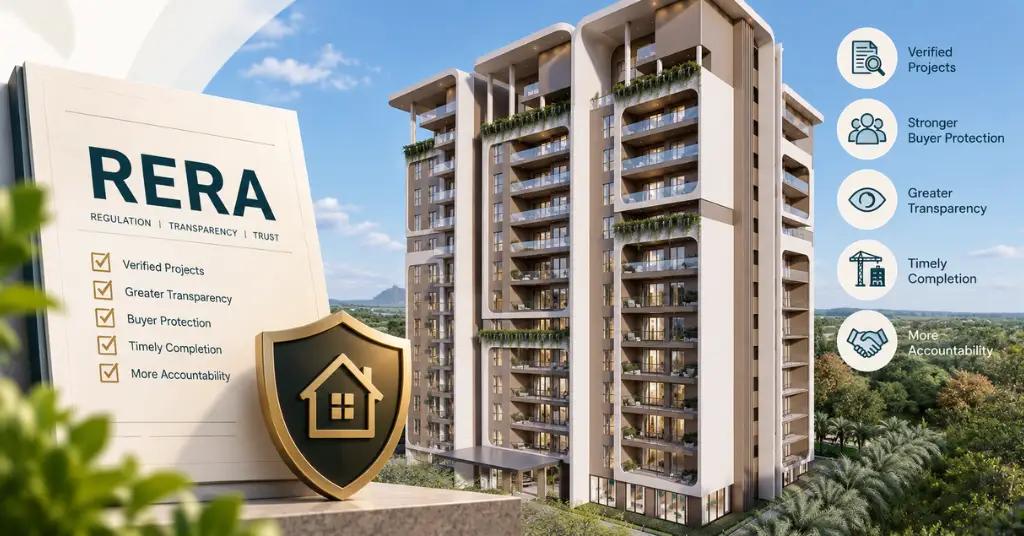
Purchasing a house is one of the major decisions in the life of a person. Though buying property is an exciting experience, the purchaser needs protection from various issues such as delay in possession, false promises made by developers, and various other problems related to real estate deals.
The Real Estate (Regulation and Development) Act, 2016, popularly known as the RERA Act, comes into play at this point.
So, what is the RERA Act in real estate, and how does it help the purchasers?
Here, in this blog, we will discuss the RERA Act, its important provisions, advantages, and points that must be checked by homebuyers before buying any property.
What Is the RERA Act in Real Estate?
The Real Estate (Regulation and Development) Act, 2016, was passed to help transform the real estate sector and create more transparency between developers and home buyers.
RERA has implemented regulations whereby eligible real estate companies and real estate dealers have to be registered with the concerned state RERA authority. It also provides home buyers with access to facts about listed projects and presents mechanisms to address certain disputes and complaints.
The law also seeks to promote transparency, accountability, and timely completion of real estate ventures such as the protection of buyers’ finances.
Because real estate is done by the title administration, specific strategies and rules can vary from nation to nation.
Why Was RERA Introduced?
Before RERA, home buyers faced many challenges e.g.
- Delay in final touches and power
- Changes in project plans without adequate information
- Lack of transparency regarding business certification
- Disputes over the actual size of the dwellings
- Unclear records of mission progress
- Large sums of money are collected from buyers before substantial development is undertaken.
- Difficulty finding remedies when commitments were no longer met
RERA was amended and designed to address many of these issues and used to bring additional fees and transparency into the arena.
Key Provisions of RERA Every Homebuyer Should Know
Understanding the principal provisions of RERA can help buyers make more informed property choices.
-
Registration of Approved Real Estate Projects
Builders are required to register proper projects with the concerned state RERA authority with the exemptions provided under the Act before marketing, advertising, booking, or promoting smart homes.
In general, projects over 500 square meters or projects involving 8 additional dwellings must be registered, although detailed rules and amendments need to be examined.
Home buyers can use the RERA portal of the applicable state to verify the business registration and evaluate the assignment data.
-
More transparency
Registered projects must provide the required data to the regulator, such as challenge details, approvals, timelines, and other applicable records.
This allows potential customers to do a good deal of due diligence before committing their cash.
-
Excessive Down Payment Protection
A sponsor may not receive more than 10% of the cost of a condominium, plot, or building as a point or application fee without first concluding a written agreement to sell with the buyer.
This provision can reduce the risk of buyers making substantial payments before formal settlement.
-
Use of carpet area
RERA emphasizes the use of period close for property-related information and transactions instead of relying on inaccurate measurements.
For home buyers, this makes it less complicated to know what usable area to buy for.
-
A separate account for project funds.
Sponsors are obliged to deposit 70% of the amounts received from allocation in a separate bank account for relevant challenges from time to time, publication of the provisions of the Act.
The budget is intended to use the basic values of that work, including clearances associated with the specific certification techniques.
This provision is intended to increase monetary discipline and reduce the conversion of the price gap between companies.
-
Structural Defect Liability
RERA provides security in respect of structural defects and labor, major, supply, or service guarantees under the Act in a specific manner.
If the sponsor is responsible for a visible disturbance within five years of acquisition, the sponsor is obliged to correct it within the prescribed period with legal assistance without the prescribed fee.
What Are the Benefits of the RERA Act in the Real Estate Industry?
The blessings of the RERA Act are extended to every buyer and responsible developer in the real estate business.
-
Excellent transparency
Buyers can gain access to important work-related information and make decisions fully based on trusted publications.
-
More responsibility
Developers are expected to adhere to the obligations and disclosures associated with their listed projects.
-
Good protection for homebuyers
RERA gives priority to buyers and presents regulatory mechanisms through which legal appeals can be addressed.
-
Abuse Reduced
Standardized information and emphasis on carpet space can help reduce confusion about task specifications and apartment sizes.
-
More organized real estate sector
The regulatory framework encourages developers and agents to operate with greater consistency and transparency and is helping to create an additional consolidated real estate market.
What Is the Impact of RERA Act on Real Estate?
The impact of RERA on real estate can be visible within the way developers, clients, and real estate agents approach luggage transactions
For manufacturers, RERA has elevated the importance of proper documentation, plans to complete tasks, financials, disclosures, and good time tracking.
For users, this has made task exploration an increasingly important part of asset purchasing for the technology.
The law also recommends displays beyond revenue displays other than classified advertising to buyers. Instead, they can verify the agenda through the RERA authority of the applicable state and evaluate the documents before making the investment.
However, RERA no longer removes every risk associated with the purchase of goods. However, buyers must freely verify title records, approvals, agreements, financing conditions, the construction is satisfactory, and various relevant matters
What About Buyback in Real Estate and the RERA Act?
The relationship between buybacks in real estate and RERA law can be confusing for home buyers.
A buyback scheme generally refers to a contractual promise where the developer or any other party has the same intention to buy the returned properties from the consumer under certain conditions, but no doubt calling the scheme “buyback” does not automatically make the scheme a buyback of the applicability of RERA.
The agreement itself, the nature of the transaction, parties involved, and relevant national legal guidelines should be examined.
Therefore, consumers should not rely entirely on verbal assurances, including guaranteed buyback or fixed returns. Such promises should actually be documented within a legally obtained agreement, including information on the purchase price, repurchase fees, timelines, and terms and conditions for each birthday celebration.
For significant property investments, it is recommended that you consult with a certified real estate attorney before signing such an agreement.
How can homebuyers check RERA-listed properties?
Before buying a property, buyers should look at the basic verification system:
- Know the RERA registration number of the challenge.
- Check the RERA website of the concerned nation.
- Search for the mission using the registration information.
- Look at the fact of the builder and assume fame.
- Review the announced finale timeline.
- Compare the facts to what the sales team communicated.
- Read the bill of sale carefully before signing.
- Verify titles, approvals, plans, specifications, and pricing terms.
RERA registration should be considered an essential part of due diligence of commodities, not as a substitute for it anymore.
RERA and Homebuyers: What Should You Remember?
RERA has changed the way consumers deal with real estate by emphasizing transparency, obligations, and regulations.
But a smart home buyer should never make a purchase option on the basis of RERA registration by me. Location, developer popularity, creation best, criminal record, company certification, pricing, services, ownership timeline, and long-term fees should also be considered
For premium residential projects, these factors emerge as particularly important because buyers are not buying truly rectangular landscapes; they are investing in long-term lifestyles and assets.
Choose a developer you can trust: Aryan Milestones
At Aryan Milestones, we believe that domestic purchasing should be based on trust, comfort, transparency, and long-term value.
With over 25 years of engineering experience, Aryan Milestones specializes in building top-priced homes in Bangalore with thoughtful planning and first-class construction The company offers state-of-the-art housing privacy, garden lighting, ventilation, architecturally compliant design plans, spatial lamp shading, top-notch
For potential homebuyers, specialization rules covering RERA are an important step towards making informed choices. At the same time, comparing a builder’s approach to construction, planning, quality, and customer experience can help consumers choose a home with added confidence.
Final Thoughts
It is important for any institution planning to buy domestically in India to understand what is RERA act in real estate. From making registration and information transparent to protection on boost bills and certain errors, RERA provides an important regulatory framework for the real estate sector.
At the same time, clients can do their own due diligence before committing and should look carefully at all property documents.
Whether you’re buying your first home or considering a residential property investment, knowledge is one of the most powerful forms of protection. With knowledge of RERA and collectively evaluating the builder, function, location, documents, and monetary terms, you can additionally make informed real estate choices.