
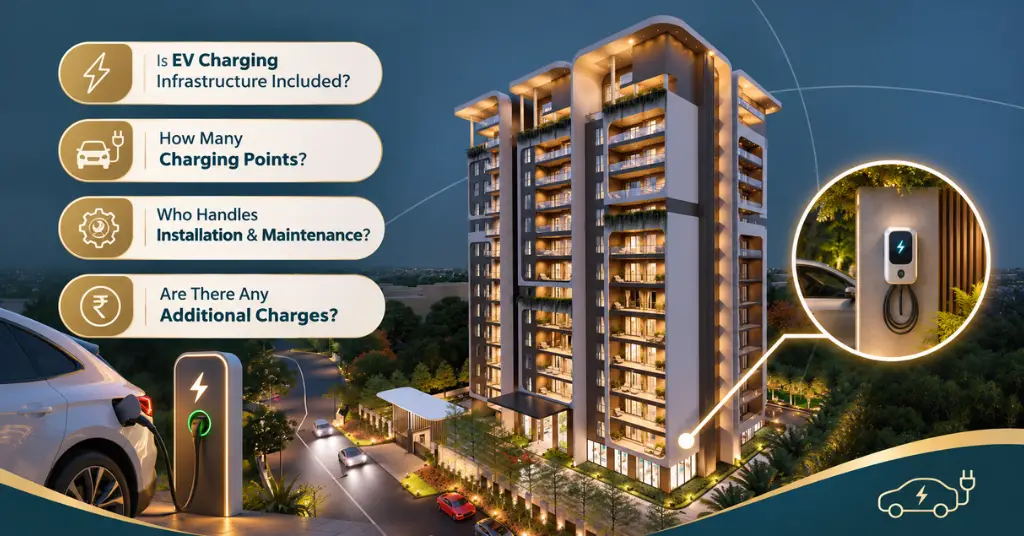
There is no denying the popularity of electric vehicles (EVs) in the country today, as people look towards greener means of transport. With the rising number of EVs, there is another aspect that potential home buyers need to consider when selecting the right home for themselves: electric vehicle charging facilities.
Think about buying an apartment and getting your first electric car, and then finding out that your apartment complex does not offer any charging facility for your car. Setting up one will require additional investments on your part.
Therefore, checking out the electric vehicle charging facilities before buying a property becomes imperative. Whether you already have a car or plan on purchasing an electric vehicle in the future, it becomes necessary to know the details about the facilities available to you.
Here are some reasons why EV charging facilities in apartments matter and what questions you must ask your builder.
Why Is EV Charging Infrastructure Important in Apartments?
In current times, the requirements for residences are changing because of changing lifestyles and modes of transportation. With increasing use of electric vehicles, the need for charging facilities is becoming a valued factor in purchasing decisions.
Following are a few reasons why EV charging infrastructure is essential:
1. Ease of Access
Charging your car from within your residential compound means that you don’t need to go to public charging stations only to charge your car.
2. Future Proofing
Even if you don’t own an electric car right now, there is always the possibility that you might buy one in the future.
3. Lower Dependency on Public Charging Points
Residential charging infrastructure will help you be less dependent on other charging points, especially for daily commuting.
4. Lifestyle Change
Current residential projects that take care of future needs in terms of mobility will be more convenient for their residents.
7 Questions to Ask Your Builder About EV Charging
However, before you go ahead with booking an apartment, make sure to check if the property has an EV charging facility.
1. Are There EV Charging Facilities in the Property?
The first question is; does the residential property have any dedicated facilities for EV charging, or does it have infrastructure where charging can be installed?
There may be some properties that provide shared charging facilities, and there could be other projects that have electrical infrastructure where individuals can install their own chargers.
If you are looking for apartments with electric car charging stations, then you should ask the builder the following questions:
- How many charging points are provided?
- Is it available for everyone?
- Where are these facilities available? Near parking spots?
- Future scope for additional charging facilities?
2. Can I Install a Private EV Charger in My Parking Space?
A private charging station makes the process of daily vehicle charging easier. But this requires an assessment of electrical considerations, parking space, safety, and building permissions.
Check if the project provides for the installation of EV chargers in apartment parking areas.
Additionally, ask if separate wiring, metering, or any other electrical work would be needed. Check if the homeowner is required to get permission from the developer or apartment complex association to install a charger.
This information could help avoid unpleasant surprises later on.
3. What Type of EV Chargers Are Available?
However, all EV chargers have different charging speeds. The two main types are AC and DC chargers.
- AC Chargers
The most common type of charger is used in houses. They are best for overnight charging, although the exact charging time may vary depending on the vehicle and charger.
- DC Fast Chargers
Faster charging of EVs, but they usually need better electrical infrastructure.
Check with your builder the type of charger, the power capacity, and the compatibility with your vehicle.
In selecting apartments with electric car charging, note that it is not everything to have a charging facility. It must also be compatible with your vehicle.
4. Can the Electrical Infrastructure Handle Multiple EVs?
It is a significant technical aspect that needs attention, especially in large residential projects.
Consider multiple people charging their electric cars at once. In case the electrical system has low capacity, it might pose problems concerning adding extra loads to the already existing capacity.
Ask the developer if the project has:
- Sufficient sanctioned electrical load.
- Separate circuits for EV charging.
- Proper earthing and electrical protection.
- Load management facility.
- Any provisions for extra charging points.
A well-planned electrical system may contribute to EV charging safety and convenience for the residents.
5. How Will The Electricity Consumption Be Charged?
Before selecting an apartment, it is essential to know the details about how the charging cost is going to be calculated.
In case the project provides a shared charging station, ask whether the charge is going to be proportional to the amount of electricity consumed or fixed.
If the apartment has a separate EV charging point, make sure that there is a separate meter or some other billing arrangement.
It is mentioned in the Ministry of Power’s 2024 EV charging infrastructure guidelines that there should be a provision of electricity connection in the residential premises for charging stations.
6. Who Will Maintain the Charging Stations?
As is the case with other facilities in apartments, EV charging stations will require maintenance to stay functional and safe.
Find out from the developer who will be in charge of maintaining the facilities after you have taken possession. Will it be the management of the apartment complex that will take care of this or will an external agency do it?
Also, find out if there will be any extra maintenance charges that residents will have to pay, and if there will be any technical help available when one of the charging points stops functioning.
An effective arrangement regarding maintenance may play an important role in determining the viability of the facility.
7. What About Expansion of EV Charging Facilities in the Future?
The rise in EV usage can affect residential parking requirements in the future. In this context, it is worth asking whether the project can accommodate any future increase in the demand for charging points.
If there are only a few charging points, it should not be difficult to incorporate enough electrical facilities for future expansion.
Will the developer have any plans regarding this?
What Do Indian Guidelines Say About EV Charging in Apartments?
The Government of India has adopted many measures to promote the use of electric vehicles and develop charging infrastructure.
The Ministry of Power has formulated the Guidelines for Installation and Operation of Electric Vehicle Charging Infrastructure, 2024.
The guidelines include the installation of charging stations at various locations like private parking spaces and group housing societies.
It also includes provisions like electricity connection, charging infrastructure, and safety norms.
But the implementation and building-related considerations can differ according to state laws. Thus, buyers should refer to the relevant building bye-laws and project approval before forming any opinion regarding the availability of the facilities.
The key point for homebuyers from the above discussion is that EV charging facilities should be planned during the electricity plan of the project, not otherwise.
How to Choose an Apartment That Supports EV-Friendly Living
In case you are looking to buy an electric car or you already have one, then you must keep the following things in mind before you reserve your apartment:
- Parking space: See whether your allocated parking space allows charging station installation.
- Electrical infrastructure: Inquire about sanctioned load, wires, and the possibility of adding more chargers.
- Charging station installation permissions: Find out whether you can install private charging stations and get the necessary permissions.
- Additional cost estimates: Think of the cost associated with installation, electricity consumption, and maintenance.
- Written guarantee: Make sure that EV charging facility promises are included in the pertinent project papers.
This list will make it easier for you to select a home that suits your current and future needs.
Final Thoughts
The development of EV charging infrastructure has become an increasingly important aspect for contemporary residential planning. With the rise in the prevalence of EVs, having easy access to EV charging facilities will make living more convenient.
In your quest for residences with EV charging facilities, don’t forget to consider other aspects apart from the availability of the facilities. Power capacity, facility compatibility, permission for installing facilities, and maintenance are equally important.
At Aryan Milestones, we are of the belief that a good house design starts with careful planning, engineering, and a dedication to excellence. The selection of a house should also take into account your future needs.
Discover meticulously planned residences developed by Aryan Milestones.
Frequently Asked Questions (FAQs)
1. Is it possible to put an EV charger at my apartment’s parking space?
Yes, the owners could be able to install their own EV chargers at their parking spaces depending on the electrical safety standards and installations.
2. Does every newly built apartment have electric car charging stations?
No, not all the apartment projects have installed EV charging stations. Some of them have shared charging stations, and some others have provisions for electric charging in the future.
3. What is the price of EV charger installation at apartments?
The price varies from one project to another depending on many factors, like the type of the charger, the power capacity of the charger, wiring distance and more.
4. What EV charger should be chosen for apartment parking?
AC chargers would usually suffice for residential use, as they allow easy nighttime charging. DC chargers are needed when faster charging is necessary; however, it will require special installation.
5. What should I look into before purchasing an apartment equipped with EV chargers?
Make sure to find out how many chargers there are, what kind of chargers are used, their capacity, permission for installation, electricity costs, maintenance, and possibilities for further development.