
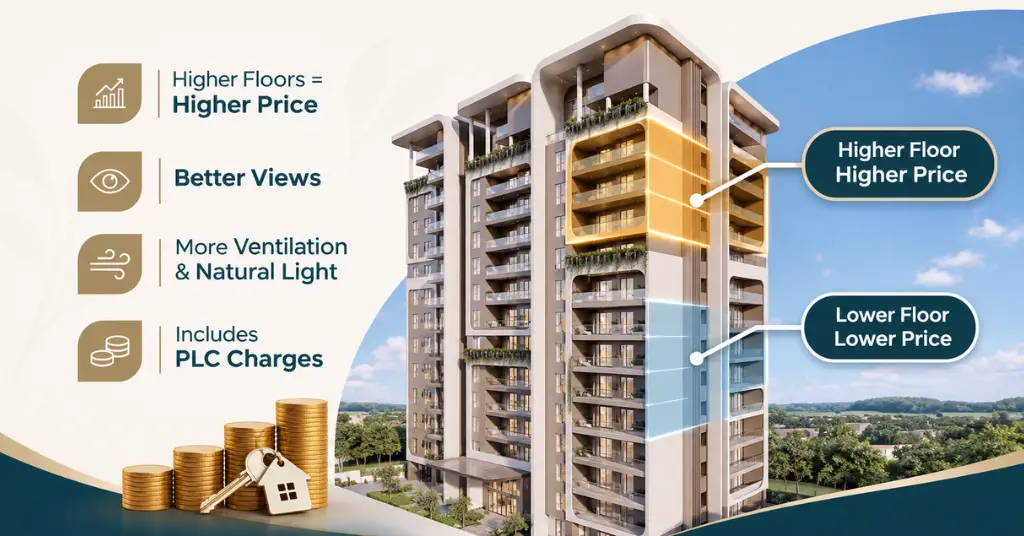
Purchasing an apartment is probably one of the most important financial investments you’ll be making. If you are comparing two similar apartments in terms of their configuration and carpet area, then you might have observed that these two apartments have different pricing just because they are located on different floors. This discrepancy arises mainly because of the floor rise charges.
Home buyers often consider the cost of the basic apartment, while they ignore the extra charges, which may increase the total cost of purchasing. Knowing about these charges before planning to buy any apartment is important.
Then, what actually are floor rise charges? What is the reason behind charging the homebuyers for higher floors? How these charges are calculated? Let’s find out.
What Are Floor Rise Charges in Real Estate?
“Floor rise costs” refer to extra fees imposed by a property developer depending on a customer’s choice of an apartment situated on higher floors. These fees are included in the general sale price of an apartment and tend to rise along with the floor level.
The logic of such a pricing strategy is based on some potential advantages of apartments located on higher floors in comparison with those located on lower levels. For instance, apartments situated on higher floors can provide a buyer with greater views, enhanced privacy, and increased access to daylight with lower noise from the streets below.
For example, an apartment located on the 12th floor of a residential building will cost more compared to an identical apartment situated on the 4th floor. The difference in the price will be defined by the floor rise charge.
Nevertheless, a floor rise charge is not a mandatory practice in all residential constructions. The applicability, prices, and calculations of such fees depend on the pricing policy of a specific builder.
Floor Rise Meaning: Why Do Builders Charge Extra for Higher Floors?
In order to have a clear understanding of the floor rise meaning, it is essential to take a closer look at how apartment pricing occurs. Typically, developers split their pricing structure into a base cost of the property along with some additional premiums depending on the apartment’s features and its location in the building.
Here are some of the reasons why the apartments on upper floors may receive a premium.
1. Better Views and Surroundings
Upper floors may provide better views of the surrounding neighborhood, greenery, and city skyline. In case of well-designed surroundings of the project, these views may make the apartments more attractive for buyers.
2. Greater Privacy
Apartments situated on higher floors usually do not have much visibility from the surrounding streets and other buildings.
3. Natural Light and Ventilation
This could be achieved based on the design of the building as well as the surrounding buildings since high-rise apartments tend to have increased exposure to sunlight and wind.
4. Lowered Street-Level Noise
Being at the upper levels of a building could result in lower noise levels due to being away from sources of noise such as traffic and other activities on the street. The level of noise is influenced by the location as well as the surroundings.
5. Demand and Pricing
Higher-level apartments are attractive to buyers due to many reasons, and the demand could be one of the aspects that developers consider when pricing their apartments.
Remember that a higher floor does not always mean a better choice. You need to consider many factors while choosing a floor to live on.
How Are Floor Rise Charges Calculated?
Knowledge of floor rise charges formula will assist you in calculating the extra amount you have to pay while buying an apartment.
In many cases, the calculation of floor rise charges depends on three important factors:
- Base floor starting from where the floor rise charge starts.
- Floor rise rate per square foot per floor.
- Chargeable area of the apartment.
The formula for floor rise charges is as follows:
Total Floor Rise Charges = No. of Chargeable Floors × Floor Rise Rate per Sq. ft. × Area of Apartment
Consider the following example for better understanding.
Floor Rise Charges Formula Example
Assume that you want to buy an apartment with the following information:
| Particulars | Details |
| Apartment Area | 1200 sq ft |
| Base floor | 5th floor |
| Selected floor | 12th floor |
| Floor rise rate | Rs. 50 per sq. ft per floor |
| Chargeable Floors | 7 |
Now, plug the values in the formula:
Step 1: Number of chargeable floors
12 − 5 = 7 floors
Step 2: Additional rate per sq. ft.
7 × ₹50 = ₹350 per sq. ft.
Step 3: Total floor rise charges
₹350 × 1,200 = ₹4,20,000
Thus, the additional amount charged by the developer will be ₹4.20 lakh.
It is a hypothetical example. The actual amounts, base floors, and area for calculating may differ from one building project to another. So, always ask for the official floor-wise cost chart from the developer before making any booking.
Are Floor Rise Charges and PLC Charges the Same?
No. While both floor rise and preferential location charges can add to the overall cost of the apartment, they are not the same.
Floor rise charges are determined by the floor level of an apartment. PLC, in contrast, means the extra cost for special location benefits that apartments have.
Illustration:
| Floor rise charges | PLC charges |
| Determined by the floor of the apartment | Determined by the preferred location of the apartment |
| Can increase in case of each chargeable floor | Can include corners, garden facing, or other preferred units |
| Mainly based on height and floor preferences | Based on the location of the apartment |
Both charges can apply to an apartment in case the developer has such a pricing policy for it. Thus, buyers need to consider the cost structure of an apartment rather than assume that it includes such charges.
What Should You Check Before Paying Floor Rise Charges?
Prior to the finalizing of an apartment, make sure to learn about the pricing system of the apartment. Below are a few important things that need to be done:
1. Ask for the Floor-Wise Price List
Get a floor-wise price list detailing the base price and the floor rise charges for each floor. This will give you a clear idea about how the cost of the apartment differs with respect to floor.
2. Know the Base Floor
Inquire about the floor, which is taken as the reference floor. While some might consider the ground floor as the reference floor, others might consider the first floor as the reference floor.
3. Get Details on the Applicable Rate
Inquire about the rate at which the charge is being applied. It can either be the per-square-foot rate, per-floor rate, percentage, or fixed rate.
4. Compare the Total Cost of Apartment
While comparing the apartments, do not just consider the base price of the apartment; take into account the cost of floor rise, PLC, parking facilities, and others.
5. Check the Cost Sheet & Agreement Document
Ensure that the cost of all the pertinent charges is stated in the cost sheet and agreement document. If anything is not explained in detail, ask the developer about it.
6. Decide If the Higher Floor Is Worth the Extra Cost
Consider your needs in day-to-day life while deciding if you should pay extra for the higher floor.
Is Paying Floor Rise Charges Worth It?
It all comes down to your preferences and budget when deciding whether to pay for floor rise charges.
In case you care about open views, increased privacy, and even better lighting, then a high floor apartment might be a good choice for you. Otherwise, if ease of access and affordability are your primary concerns, then a low floor apartment might suit your needs just fine.
Don’t opt for an apartment just because it’s on a higher floor than others, but rather consider the design and other factors.
Here at Aryan Milestones, we do not think that choosing an apartment is about its location and price alone. We offer our clients to choose their dream home, which will match their lifestyle and provide value for a lifetime. Our developments demonstrate the importance of engineering accuracy and comfort of living.
Final Thoughts
The issue of floor rise prices is essential for any apartment buyer to be aware of before purchasing a unit. The benefits provided by high floors like a good view, privacy, and more natural light must always be compared with the costs involved.
Learning about the floor rise charges definition and analyzing all the related figures can save you from any unpleasant surprises and help you choose wisely.
Ultimately, a suitable apartment is not the one at the top but the one that provides a suitable combination of comfort and quality for your money.
Frequently Asked Questions
1. What are floor rise charges in real estate?
Floor rise charges are extra charges that are levied by developers when buyers opt for apartments on higher floors. Floor rise charges usually depend on the area of the apartment and floor, along with the price policy applicable to the apartment by the developer.
2. What is floor rise in an apartment?
The term ‘floor rise’ is used in reference to the increment in cost of an apartment according to the floor it is located on. High-floor apartments might be priced higher due to the presence of advantages like scenic views and privacy.
3. How are floor rise charges calculated?
Floor rise charges are usually calculated through multiplication of number of chargeable floors by the price per square foot applicable to that floor and the area of the apartment.
4. Is payment of floor rise charges compulsory in the case of the purchase of an apartment?
The payment of floor rise charges is not compulsorily required. It depends upon the pricing policy of the builder and the terms and conditions of purchase of the property. The buyers need to look into the price list and agreement in this regard.
5. Will floor rise charges be refunded in case I cancel my booking of an apartment?
Whether floor rise charges will be refunded or not in case of cancellation of booking depends upon the terms and conditions of the booking.