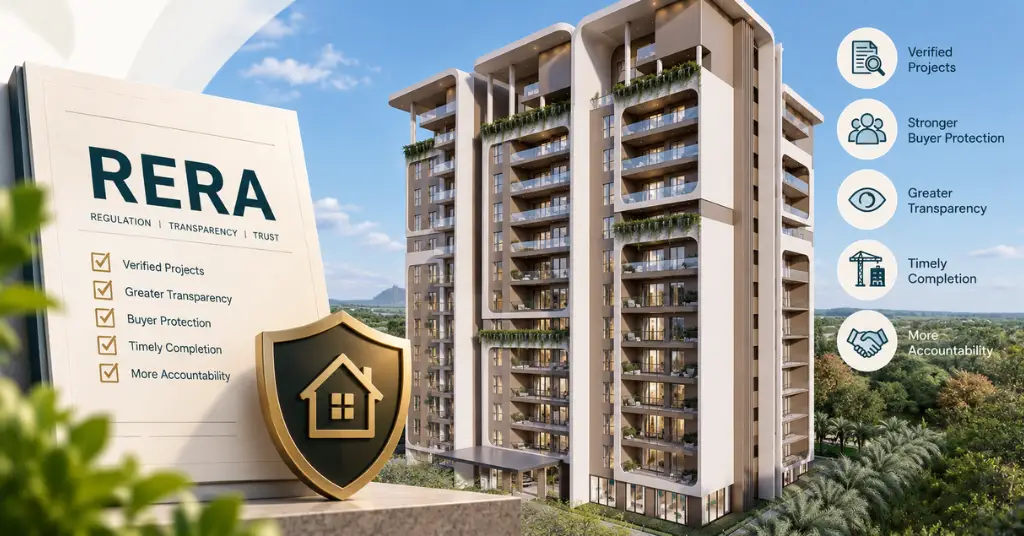
What Is the RERA Act in Real Estate? A Complete Guide for Homebuyers in India

What Is the RERA Act in Real Estate? A Complete Guide for Homebuyers in India

Purchasing a house is one of the major decisions in the life of a person. Though buying property is an exciting experience, the purchaser needs protection from various issues such as delay in possession, false promises made by developers, and various other problems related to real estate deals. 

The Real Estate (Regulation and Development) Act, 2016, popularly known as the RERA Act, comes into play at this point.

So, what is the RERA Act in real estate, and how does it help the purchasers? 

Here, in this blog, we will discuss the RERA Act, its important provisions, advantages, and points that must be checked by homebuyers before buying any property.

What Is the RERA Act in Real Estate?

The Real Estate (Regulation and Development) Act, 2016, was passed to help transform the real estate sector and create more transparency between developers and home buyers.

RERA has implemented regulations whereby eligible real estate companies and real estate dealers have to be registered with the concerned state RERA authority. It also provides home buyers with access to facts about listed projects and presents mechanisms to address certain disputes and complaints.

The law also seeks to promote transparency, accountability, and timely completion of real estate ventures such as the protection of buyers’ finances.

Because real estate is done by the title administration, specific strategies and rules can vary from nation to nation.

Why Was RERA Introduced?

Before RERA, home buyers faced many challenges e.g.

  • Delay in final touches and power
  • Changes in project plans without adequate information
  • Lack of transparency regarding business certification
  • Disputes over the actual size of the dwellings
  • Unclear records of mission progress
  • Large sums of money are collected from buyers before substantial development is undertaken.
  • Difficulty finding remedies when commitments were no longer met

RERA was amended and designed to address many of these issues and used to bring additional fees and transparency into the arena.

Key Provisions of RERA Every Homebuyer Should Know

Understanding the principal provisions of RERA can help buyers make more informed property choices.

  • Registration of Approved Real Estate Projects

Builders are required to register proper projects with the concerned state RERA authority with the exemptions provided under the Act before marketing, advertising, booking, or promoting smart homes.

In general, projects over 500 square meters or projects involving 8 additional dwellings must be registered, although detailed rules and amendments need to be examined.

Home buyers can use the RERA portal of the applicable state to verify the business registration and evaluate the assignment data.

  • More transparency

Registered projects must provide the required data to the regulator, such as challenge details, approvals, timelines, and other applicable records.

This allows potential customers to do a good deal of due diligence before committing their cash.

  • Excessive Down Payment Protection

A sponsor may not receive more than 10% of the cost of a condominium, plot, or building as a point or application fee without first concluding a written agreement to sell with the buyer.

This provision can reduce the risk of buyers making substantial payments before formal settlement.

  • Use of carpet area

RERA emphasizes the use of period close for property-related information and transactions instead of relying on inaccurate measurements.

For home buyers, this makes it less complicated to know what usable area to buy for.

  • A separate account for project funds.

Sponsors are obliged to deposit 70% of the amounts received from allocation in a separate bank account for relevant challenges from time to time, publication of the provisions of the Act.

The budget is intended to use the basic values ​​of that work, including clearances associated with the specific certification techniques.

This provision is intended to increase monetary discipline and reduce the conversion of the price gap between companies.

  • Structural Defect Liability

RERA provides security in respect of structural defects and labor, major, supply, or service guarantees under the Act in a specific manner.

If the sponsor is responsible for a visible disturbance within five years of acquisition, the sponsor is obliged to correct it within the prescribed period with legal assistance without the prescribed fee.

What Are the Benefits of the RERA Act in the Real Estate Industry?

The blessings of the RERA Act are extended to every buyer and responsible developer in the real estate business.

  • Excellent transparency

Buyers can gain access to important work-related information and make decisions fully based on trusted publications.

  • More responsibility

Developers are expected to adhere to the obligations and disclosures associated with their listed projects.

  • Good protection for homebuyers

RERA gives priority to buyers and presents regulatory mechanisms through which legal appeals can be addressed.

  • Abuse Reduced

Standardized information and emphasis on carpet space can help reduce confusion about task specifications and apartment sizes.

  • More organized real estate sector

The regulatory framework encourages developers and agents to operate with greater consistency and transparency and is helping to create an additional consolidated real estate market.

What Is the Impact of RERA Act on Real Estate?

The impact of RERA on real estate can be visible within the way developers, clients, and real estate agents approach luggage transactions

For manufacturers, RERA has elevated the importance of proper documentation, plans to complete tasks, financials, disclosures, and good time tracking.

For users, this has made task exploration an increasingly important part of asset purchasing for the technology.

The law also recommends displays beyond revenue displays other than classified advertising to buyers. Instead, they can verify the agenda through the RERA authority of the applicable state and evaluate the documents before making the investment.

However, RERA no longer removes every risk associated with the purchase of goods. However, buyers must freely verify title records, approvals, agreements, financing conditions, the construction is satisfactory, and various relevant matters

What About Buyback in Real Estate and the RERA Act?

The relationship between buybacks in real estate and RERA law can be confusing for home buyers.

A buyback scheme generally refers to a contractual promise where the developer or any other party has the same intention to buy the returned properties from the consumer under certain conditions, but no doubt calling the scheme “buyback” does not automatically make the scheme a buyback of the applicability of RERA.

The agreement itself, the nature of the transaction, parties involved, and relevant national legal guidelines should be examined.

Therefore, consumers should not rely entirely on verbal assurances, including guaranteed buyback or fixed returns. Such promises should actually be documented within a legally obtained agreement, including information on the purchase price, repurchase fees, timelines, and terms and conditions for each birthday celebration.

For significant property investments, it is recommended that you consult with a certified real estate attorney before signing such an agreement.

How can homebuyers check RERA-listed properties?

Before buying a property, buyers should look at the basic verification system:

  1. Know the RERA registration number of the challenge.
  2. Check the RERA website of the concerned nation.
  3. Search for the mission using the registration information.
  4. Look at the fact of the builder and assume fame.
  5. Review the announced finale timeline.
  6. Compare the facts to what the sales team communicated.
  7. Read the bill of sale carefully before signing.
  8. Verify titles, approvals, plans, specifications, and pricing terms.

RERA registration should be considered an essential part of due diligence of commodities, not as a substitute for it anymore.

RERA and Homebuyers: What Should You Remember?

RERA has changed the way consumers deal with real estate by emphasizing transparency, obligations, and regulations.

But a smart home buyer should never make a purchase option on the basis of RERA registration by me. Location, developer popularity, creation best, criminal record, company certification, pricing, services, ownership timeline, and long-term fees should also be considered

For premium residential projects, these factors emerge as particularly important because buyers are not buying truly rectangular landscapes; they are investing in long-term lifestyles and assets.

Choose a developer you can trust: Aryan Milestones

At Aryan Milestones, we believe that domestic purchasing should be based on trust, comfort, transparency, and long-term value.

With over 25 years of engineering experience, Aryan Milestones specializes in building top-priced homes in Bangalore with thoughtful planning and first-class construction The company offers state-of-the-art housing privacy, garden lighting, ventilation, architecturally compliant design plans, spatial lamp shading, top-notch

For potential homebuyers, specialization rules covering RERA are an important step towards making informed choices. At the same time, comparing a builder’s approach to construction, planning, quality, and customer experience can help consumers choose a home with added confidence.

Final Thoughts

It is important for any institution planning to buy domestically in India to understand what is RERA act in real estate. From making registration and information transparent to protection on boost bills and certain errors, RERA provides an important regulatory framework for the real estate sector.

At the same time, clients can do their own due diligence before committing and should look carefully at all property documents.

Whether you’re buying your first home or considering a residential property investment, knowledge is one of the most powerful forms of protection. With knowledge of RERA and collectively evaluating the builder, function, location, documents, and monetary terms, you can additionally make informed real estate choices.

Related Blogs

Browse insights across categories to find what matters most to you.

Best Area to Invest in Bangalore for Homebuyers: Why JP Nagar Stands Out

Bangalore has emerged as one of the most popular cities in India for those who are buying homes and investing in real estate properties.

But along with selecting the ideal apartment, selecting the right locality plays an important role in determining the property value of a place. Properties that offer connectivity, social infrastructure, developed area, and other factors may be highly valued.

JP Nagar is one of the most popular residential areas in South Bangalore. The reason for the popularity of this area is its connectivity, convenience, and residential aspect.

No matter whether you are buying your first home or looking for investment property, knowing the advantages of JP Nagar will help you make an informed decision.

Let us look at why JP Nagar deserves to be considered if you are looking for the best place to invest in Bangalore.

Why Is JP Nagar a Popular Residential Destination in Bangalore?

JP Nagar is a well-established residential area in the southern part of Bangalore with well-organized residential localities and proximity to various everyday conveniences.

JP Nagar covers several phases and provides housing options in the form of independent houses, flats, commercial buildings, and gated residential societies.

Some of the factors that make it an attractive area to buy homes are listed below:

  • Established residential areas.
  • Presence of schools, hospitals, and shopping complexes.
  • Good connectivity to key roads and employment centers.
  • Options of different kinds of residential properties.
  • Parks, recreation centers, and lifestyle amenities.

As opposed to areas that have not yet developed their basic infrastructure, JP Nagar already enjoys an established residential ecosystem.

Reasons Why JP Nagar Stands Out for Property Investment

1. Strategic Location and Connectivity

Location is very crucial while assessing the various investment options for properties. The area of JP Nagar has the advantage of location, being located in South Bangalore and with easy connection with neighboring commercial and residential zones.

It has good connectivity via various roads like Bannerghatta Road, Kanakapura Road, and the NICE Road corridor. Such connectivity enables people living in the zone to reach various parts of Bangalore like Jayanagar, Banashankari, BTM Layout, and Electronic City.

Another advantage of the area is its metro connectivity. The existing Green Line is connecting some zones in JP Nagar, like Jaya Prakash Nagar and Yelachenahalli.

The upcoming metro line, the Pink Line, has an elevated portion in the JP Nagar 4th Phase and will provide better connectivity along Bannerghatta Road. 

The elevated portion covering 7.5 km has been cleared for safety in October 2026 and now awaits inauguration for passengers by the start of November 2026.

2. Well-Developed Social Infrastructure

The right choice of residential area should not only be based on nice flats or apartments but also on the availability of necessary services that can make life easy and also play a role in making it a desirable place to live in the future.

There is an excellent social infrastructure available in JP Nagar, including:

  • Educational Institutions: Availability of educational institutions such as Orchids The International School, Redbridge International Academy, etc.
  • Healthcare Services: Availability of healthcare services such as Aster Hospital, Manipal Hospital, Fortis Hospital, and many other healthcare services in nearby locations.
  • Shopping and Entertainment: There are some shopping malls like Forum South Bangalore and Nexus Vega City Mall, where one can do shopping, entertainment, and many other things.

Thus, it makes JP Nagar a good choice for families and individuals.

3. Access to Employment and Business Hubs

The employment environment of Bangalore is one of the main aspects affecting its residential property market.

The connectivity of the JP Nagar area to many business and employment centers in South Bangalore is provided by the existing road network.

Commercial developments and employment centers in the vicinity can create the demand for residential properties from professionals who need convenient accommodation.

This aspect is essential for investors in property markets since proximity to business centers may determine the demand for apartments and tenants.

4. Balanced Life Style with Parks and Recreation Facilities

In modern society, the growing number of people choose residential areas offering both convenient conditions for urban life and comfortable accommodation.

JP Nagar has a lot of parks, green spaces, restaurants, and recreational facilities contributing to the attractiveness of this locality.

Among natural sites worth mentioning in this respect, there are Sarakki Lake and Puttenahalli Lake. Also, localities have parks and places for walking.

The balance between residential and commercial zones allows residents to meet their daily needs without going a long way to do shopping.

5. Different Residential Options for Homebuyers

One of the features of JP Nagar is the diversity of the residential property options in the various phases.

Customers have access to both individual houses and apartments based on their requirements and financial capacity.

The earlier phases are usually more mature compared to the later phases, which include JP Nagar 7th Phase and JP Nagar 8th Phase.

Thus, this makes this locality significant for various categories of customers who could be families or investors.

However, there are many variations in terms of price and investment value for property based on the particular location.

Which Part of JP Nagar Should You Consider?

There are different phases in JP Nagar, each having a unique residential experience to offer.

JP Nagar Phase 

  • 1st-3rd Phase: Well-established residential colonies with good connectivity to Jayanagar and amenities available.
  • 4th-6th Phase: A combination of residential and commercial activities with good connectivity to major roads and lifestyle amenities. 
  • 7th-8th Phase: Relatively new residential layouts with good connectivity to Kanakapura Road and NICE Road

It is all about picking the right phase according to your requirements. If you are looking for well-established neighborhoods, the former might suit you better. However, if you are looking for relatively new residential layouts, then the latter might just be what you need.

It is always advisable to consider the exact location of the project and not the JP Nagar name alone.

What Should You Check Before Investing in JP Nagar?

While considering a property, there are certain important factors that should be kept in mind:

  1. Location & Accessibility: Determine the proximity of the property to metro stations, highways, and nearby places.
  2. Reputable Developer: Find out about the developer’s experience of building properties and their construction standards.
  3. Legal Documentation: See if the property is registered in RERA and other legal documentation and clearances are obtained.
  4. Amenities and Specifications: The facilities provided in the property and its specifications.
  5. Overall Cost of Investment: This would include base price, registration fees, taxes, and other costs, like for parking facilities.
  6. Future Demands: Select a property according to your family’s future demands and needs.

Final Thoughts

The selection of the right locality plays an important role in ensuring the success of real estate investments. Among the many interesting places for residence in Bangalore, JP Nagar is considered the best one owing to its developed infrastructure, connectivity options, and access to places of employment.

JP Nagar can be considered the best area in Bangalore for real estate investors considering current advantages as well as the possibilities of future connectivity.

Nonetheless, any good investment requires thorough research and realistic planning of finances along with assessing the selected property.

At Aryan Milestones, we are convinced that the house has to give more than just a nice address. Therefore, it has to be designed with comfort in mind and built with high-quality materials.

Find out all the advantages of your future home, Aryan Alturra, in JP Nagar 8th Phase.

Frequently Asked Questions (FAQs)

1. Is it a good choice to invest in JP Nagar, Bangalore?

Yes, JP Nagar can be a good choice owing to its existing residential infrastructure, connectivity by metro rail, educational institutes, healthcare services, and employment opportunities. Yet, the investment suitability will depend on the particular property and the cost of purchase.

2. Which phase is the best for buying an apartment at JP Nagar?

It will depend on you since some people like already developed locations whereas others would like to check out newly constructed residential units. It can be either one of the earlier phases or the 7th and 8th phases of JP Nagar.

3. Is JP Nagar one of the developing places in Bangalore?

JP Nagar is an established residential place and not fully emerging. Still, the current infrastructure development is adding value to the future connectivity of this locality.

4. What factors do I need to consider when deciding to invest in property in Bangalore?

Think about location, connectivity, developer’s reputation, RERA compliance, quality of construction, amenities available, total cost of purchasing, and rent demand before you make your choice.

5. Why should prospective buyers take into account Aryan Alturra in JP Nagar?

Aryan Alturra is a residential project developed by Aryan Milestones in JP Nagar 8th Phase, offering 3BHK homes and a few 4BHK duplexes.

Bangalore has emerged as one of the most popular cities in India for those who are buying

Vastu Check for a 2BHK Flat Plan: What to Look For Before Booking

The purchase of a house is a big deal, and while deciding on an apartment, one must consider not just its location, cost, and features, but other factors as well. Many Indians consider Vastu Shastra while looking for a property. 

There are many aspects that influence the planning of a home from the orientation of its main door to the positioning of the kitchen and bedrooms.

While buying a 2BHK apartment, some knowledge about the principles of Vastu will come handy for analyzing the floor plan and make a decision about booking.

So, what should you pay attention to while examining the Vastu for the 2BHK flat layout? What are the favorable directions for different rooms, and how do you determine whether the property has a correct alignment?

Let’s take a closer look at the most important points to consider before buying your dream home.

Why Is Vastu Important When Choosing a 2BHK Flat?

Vastu Shastra is a classical architectural tradition from India, which mainly deals with directions and positioning of spaces inside a building.

The position of rooms and entry points is believed to have an impact on the general environment of a house; hence, many people who buy a new home take into consideration Vastu.

An appropriately designed apartment can also provide practical advantages like efficient use of space and ventilation.

But Vastu is not the only thing you need to keep in mind when you are buying an apartment.

Important Vastu Checks for a 2BHK Flat Plan

Before selecting an apartment, one must study the floor plan and find out how different rooms are arranged. There are seven major areas one needs to pay attention to.

1. Find Out About the Orientation of the Main Entrance

The main entrance is among the most significant components of Vastu Shastra. Generally, north, east, and some northeast entrances are preferred.

When studying the entrance, one should focus on the following aspects:

  • What direction the main entrance faces;
  • Is there sufficient space around the entrance, and does the entrance look open;
  • Is there sufficient natural light close to the entrance?
  • Does the entrance ensure residents’ privacy.

It is also desirable for the entrance to be comfortable for everyday movements and not interfere with the general arrangement of the apartment.

2. Study Kitchen Location

Another important area in a home layout based on the Vastu principles is the kitchen. As per traditional ideas, the southeast direction is preferred for kitchen location. Alternatively, the north-west may be used.

Here are some commonly accepted recommendations:

  • Location of the cooking space towards the south-east.
  • Location of the cooking space such that the person cooking faces east.
  • Separation of the cooking space from the washing space.
  • Ventilation and natural light should be adequate.

When analyzing the layout of a 2 BHK flat plan in vastu principles, consider the space for cooking, storage, and moving around within the kitchen.

3. Analysis of the Direction of the Master Bedroom

It is preferred that the master bedroom be located towards the southwest according to the Vastu principles.

The master bedroom is considered to be a place for relaxation and calmness. Considerations while analyzing this space should include the following:

  • Sufficient space in the room for furniture placement.
  • Adequate space in the room for a comfortable bed position.
  • Ventilation should be sufficient.
  • Privacy in the room should be considered.

4. Check the Placement of the Second Bedroom

In a 2BHK flat, the second bedroom can be used as a kids’ bedroom, guest bedroom, or study room.

As per general Vastu guidelines, the west and northwest directions are deemed ideal locations for a second bedroom.

Ensure there is proper lighting, ventilation, space, and privacy in the room before you decide to rent it.

Your room should have enough space to hold all your furnishings and activities as per your family requirements.

5. Analyze the Bathroom & Toilet Location

The location of the bathroom and toilet is another criterion that most people take into account while conducting Vastu analysis for flat selection.

According to traditional Vastu rules, the west and northwest directions are generally preferred for a bathroom and toilets, while the northeast direction is ideal for an open space.

However, practicality should always prevail over any traditional belief. Consider:

  • Proper drainage facilities.
  • Proper waterproofing.
  • Ventilation.
  • Plumbing arrangements.
  • Wet and dry area separation, wherever feasible.

All these aspects are important for ensuring good hygiene conditions and avoiding future problems.

6. Check Natural Light and Ventilation

The house should be well-lit and ensure adequate flow of air.

Although, according to Vastu Shastra, the direction of placement of the house matters, natural light and ventilation are also practical considerations that must influence your choice.

Ensure there are enough windows allowing natural light to enter living rooms and bedrooms. Ensure that the kitchen has proper ventilation and bathrooms have proper exhaust or ventilation facilities.

Natural light and fresh air can make a house comfortable and pleasant to live in.

7. Analyze Room Layout

Lastly, consider the overall arrangement of rooms in the apartment.

It is necessary to analyze the layout of the apartment as a whole and not consider rooms individually when determining whether it is a vastu-compliant flat layout or not.

Consider whether:

  • There is enough space in the living room.
  • Bedrooms are private.
  • The kitchen is easily accessible.
  • Passage areas are not too long.
  • There is enough storage space and space for furniture in the apartment.

How to Perform a Vastu Check for a Flat Online?

You do not have to physically go and check all apartments before doing a Vastu check for a particular property. Instead, you can start with an online Vastu check for flat based on the floor plan provided by the builder.

You need to follow these easy steps:

Step 1: Get the Floor Plan: Aryan Milestones indicating the entry point, rooms, kitchen, bathrooms, and balconies.

Step 2: Directions: See if the north direction is mentioned in the floor plan. In case it is not mentioned, ask for a properly oriented floor plan and not the one where the top direction is considered to be north.

Step 3: Mark the Room Locations: Find the location of the entrance, kitchen, master bedroom, second bedroom, and bathrooms.

Step 4: Follow Vastu Principles: Review the locations of these rooms as per the generally followed principles of Vastu Shastra.

Step 5: Consider Consulting an Expert: If Vastu plays a crucial role in your decision-making process, it is better to consult an expert on this matter.

What Makes a Flat Vastu Compliant?

The term vastu compliant flat usually denotes an apartment having a layout design that complies with commonly known principles of Vastu Shastra.

Nevertheless, there is no universal list of recommendations used by all Vastu experts. Guidelines may vary from one approach to another depending on the tradition, interpretation, and position of the building.

Final Thoughts

A decision to buy a 2BHK flat is based on choosing the most suitable place that meets all your family requirements. Vastu Shastra may become one of the aspects that you have to take into consideration when evaluating various floor plans, especially if you value traditions in architecture.

It is advisable to pay particular attention to the entrance, kitchen, bedrooms, bathrooms, and the arrangement of rooms before booking. In this way, a thorough vastu flat plan analysis will help to realize whether the flat meets all your preferences.

At Aryan Milestones, we consider the process of creating a perfect home as the process that includes not only the choice of the most appropriate layout but also proper construction and space utilization.

Discover our thoughtfully designed residential complexes and feel the confidence in making your choice.

Frequently Asked Questions (FAQs)

1. What would be the best direction for a 2BHK flat according to Vastu?

Entrances facing towards north and east are traditionally thought to be lucky directions. Overall luck of the flat, however, depends on its whole design and distribution of different rooms.

2. What would be the best direction for the kitchen in a 2BHK flat?

The most preferable direction for a kitchen in accordance with the rules of Vastu is southeast. Northwest may serve as an alternative.

3. How to know if a flat is Vastu compliant?

One can begin with checking the layout of the flat in order to see which way faces the north and the other directions and the position of the entrance, kitchen, bedrooms, and toilets. One can get an expert consultation as well.

4. Can I do a Vastu check on a flat online?

Yes. It is possible to use the digital plan of the flat for carrying out an initial Vastu analysis. It is important that all directions and room placements would be indicated in the drawing. In order to receive a more detailed analysis, one needs to consult with a Vastu expert.

5. Is it mandatory to go for a 100% Vastu-compliant flat?

No, selection of a Vastu-compliant flat is purely subjective. You also need to consider the quality of construction, ventilation, sunlight, location, cost, and the comfort level of your family before deciding.

The purchase of a house is a big deal, and while deciding on an apartment, one must

EV Charging in Apartments: What to Ask the Builder Before You Book

There is no denying the popularity of electric vehicles (EVs) in the country today, as people look towards greener means of transport. With the rising number of EVs, there is another aspect that potential home buyers need to consider when selecting the right home for themselves: electric vehicle charging facilities.

Think about buying an apartment and getting your first electric car, and then finding out that your apartment complex does not offer any charging facility for your car. Setting up one will require additional investments on your part.

Therefore, checking out the electric vehicle charging facilities before buying a property becomes imperative. Whether you already have a car or plan on purchasing an electric vehicle in the future, it becomes necessary to know the details about the facilities available to you.

Here are some reasons why EV charging facilities in apartments matter and what questions you must ask your builder.

Why Is EV Charging Infrastructure Important in Apartments?

In current times, the requirements for residences are changing because of changing lifestyles and modes of transportation. With increasing use of electric vehicles, the need for charging facilities is becoming a valued factor in purchasing decisions.

Following are a few reasons why EV charging infrastructure is essential:

1. Ease of Access

Charging your car from within your residential compound means that you don’t need to go to public charging stations only to charge your car.

2. Future Proofing

Even if you don’t own an electric car right now, there is always the possibility that you might buy one in the future.

3. Lower Dependency on Public Charging Points

Residential charging infrastructure will help you be less dependent on other charging points, especially for daily commuting.

4. Lifestyle Change

Current residential projects that take care of future needs in terms of mobility will be more convenient for their residents.

7 Questions to Ask Your Builder About EV Charging

However, before you go ahead with booking an apartment, make sure to check if the property has an EV charging facility.

1. Are There EV Charging Facilities in the Property?

The first question is; does the residential property have any dedicated facilities for EV charging, or does it have infrastructure where charging can be installed?

There may be some properties that provide shared charging facilities, and there could be other projects that have electrical infrastructure where individuals can install their own chargers.

If you are looking for apartments with electric car charging stations, then you should ask the builder the following questions:

  • How many charging points are provided?
  • Is it available for everyone?
  • Where are these facilities available? Near parking spots?
  • Future scope for additional charging facilities?

2. Can I Install a Private EV Charger in My Parking Space?

A private charging station makes the process of daily vehicle charging easier. But this requires an assessment of electrical considerations, parking space, safety, and building permissions.

Check if the project provides for the installation of EV chargers in apartment parking areas.

Additionally, ask if separate wiring, metering, or any other electrical work would be needed. Check if the homeowner is required to get permission from the developer or apartment complex association to install a charger.

This information could help avoid unpleasant surprises later on.

3. What Type of EV Chargers Are Available?

However, all EV chargers have different charging speeds. The two main types are AC and DC chargers.

  • AC Chargers 

The most common type of charger is used in houses. They are best for overnight charging, although the exact charging time may vary depending on the vehicle and charger.

  • DC Fast Chargers

Faster charging of EVs, but they usually need better electrical infrastructure.

Check with your builder the type of charger, the power capacity, and the compatibility with your vehicle.

In selecting apartments with electric car charging, note that it is not everything to have a charging facility. It must also be compatible with your vehicle.

4. Can the Electrical Infrastructure Handle Multiple EVs?

It is a significant technical aspect that needs attention, especially in large residential projects.

Consider multiple people charging their electric cars at once. In case the electrical system has low capacity, it might pose problems concerning adding extra loads to the already existing capacity.

Ask the developer if the project has:

  • Sufficient sanctioned electrical load.
  • Separate circuits for EV charging.
  • Proper earthing and electrical protection.
  • Load management facility.
  • Any provisions for extra charging points.

A well-planned electrical system may contribute to EV charging safety and convenience for the residents.

5. How Will The Electricity Consumption Be Charged?

Before selecting an apartment, it is essential to know the details about how the charging cost is going to be calculated.

In case the project provides a shared charging station, ask whether the charge is going to be proportional to the amount of electricity consumed or fixed.

If the apartment has a separate EV charging point, make sure that there is a separate meter or some other billing arrangement.

It is mentioned in the Ministry of Power’s 2024 EV charging infrastructure guidelines that there should be a provision of electricity connection in the residential premises for charging stations.

6. Who Will Maintain the Charging Stations?

As is the case with other facilities in apartments, EV charging stations will require maintenance to stay functional and safe.

Find out from the developer who will be in charge of maintaining the facilities after you have taken possession. Will it be the management of the apartment complex that will take care of this or will an external agency do it?

Also, find out if there will be any extra maintenance charges that residents will have to pay, and if there will be any technical help available when one of the charging points stops functioning.

An effective arrangement regarding maintenance may play an important role in determining the viability of the facility.

7. What About Expansion of EV Charging Facilities in the Future?

The rise in EV usage can affect residential parking requirements in the future. In this context, it is worth asking whether the project can accommodate any future increase in the demand for charging points.

If there are only a few charging points, it should not be difficult to incorporate enough electrical facilities for future expansion.

Will the developer have any plans regarding this?

What Do Indian Guidelines Say About EV Charging in Apartments?

The Government of India has adopted many measures to promote the use of electric vehicles and develop charging infrastructure.

The Ministry of Power has formulated the Guidelines for Installation and Operation of Electric Vehicle Charging Infrastructure, 2024. 

The guidelines include the installation of charging stations at various locations like private parking spaces and group housing societies.

It also includes provisions like electricity connection, charging infrastructure, and safety norms.

But the implementation and building-related considerations can differ according to state laws. Thus, buyers should refer to the relevant building bye-laws and project approval before forming any opinion regarding the availability of the facilities.

The key point for homebuyers from the above discussion is that EV charging facilities should be planned during the electricity plan of the project, not otherwise.

How to Choose an Apartment That Supports EV-Friendly Living

In case you are looking to buy an electric car or you already have one, then you must keep the following things in mind before you reserve your apartment:

  • Parking space: See whether your allocated parking space allows charging station installation.
  • Electrical infrastructure: Inquire about sanctioned load, wires, and the possibility of adding more chargers.
  • Charging station installation permissions: Find out whether you can install private charging stations and get the necessary permissions.
  • Additional cost estimates: Think of the cost associated with installation, electricity consumption, and maintenance.
  • Written guarantee: Make sure that EV charging facility promises are included in the pertinent project papers.

This list will make it easier for you to select a home that suits your current and future needs.

Final Thoughts

The development of EV charging infrastructure has become an increasingly important aspect for contemporary residential planning. With the rise in the prevalence of EVs, having easy access to EV charging facilities will make living more convenient.

In your quest for residences with EV charging facilities, don’t forget to consider other aspects apart from the availability of the facilities. Power capacity, facility compatibility, permission for installing facilities, and maintenance are equally important.

At Aryan Milestones, we are of the belief that a good house design starts with careful planning, engineering, and a dedication to excellence. The selection of a house should also take into account your future needs.

Discover meticulously planned residences developed by Aryan Milestones.

Frequently Asked Questions (FAQs)

1. Is it possible to put an EV charger at my apartment’s parking space?

Yes, the owners could be able to install their own EV chargers at their parking spaces depending on the electrical safety standards and installations.

2. Does every newly built apartment have electric car charging stations?

No, not all the apartment projects have installed EV charging stations. Some of them have shared charging stations, and some others have provisions for electric charging in the future.

3. What is the price of EV charger installation at apartments?

The price varies from one project to another depending on many factors, like the type of the charger, the power capacity of the charger, wiring distance and more.

4. What EV charger should be chosen for apartment parking?

AC chargers would usually suffice for residential use, as they allow easy nighttime charging. DC chargers are needed when faster charging is necessary; however, it will require special installation. 

5. What should I look into before purchasing an apartment equipped with EV chargers?

Make sure to find out how many chargers there are, what kind of chargers are used, their capacity, permission for installation, electricity costs, maintenance, and possibilities for further development.


There is no denying the popularity of electric vehicles (EVs) in the country today, as people look

Scroll to Top